Friday, 17 October 2014

Bara Lawr

So I recently decided to make bara lawr (laverbread, literally のりパン) for the staff at GenkiJACS. There are various reasons. One is that it came up in conversation a couple of times. I wondered whether people here wouldn't like it, considering savoury seaweed foods are a pretty major thing here. I was interested in the challenge of making passable bara lawr here. And I just sort of felt like it.

The main obstacle is that although nori is very similar to the lawr I'd normally use, it's processed differently. Lawr I buy tinned and boiled; it's soft and salty. Searching for nori, I was only able to find it roasted and dried into sheets or shreds. This makes a substantial difference to the flavour, that evasively indescribable roastedness, and also leaves it far less salty. However, a few notes around the internet suggested that it can be done.

The absolute first step will, perhaps, seem very strange in making a seaweed-based recipe. I went to several shops, and eventually managed to buy a packet of bacon.

I began by shredding sheets of yakinori (roasted nori) and putting it to soak. I was relieved to find the seaweed readily absorbed the water and reconstituted into a familiar green slime, although it took a lot of mixing to break it up from the chunks it had been pressed into, and it didn't quite achieve the texture I'm used to by the time I gave up. I chucked in a bit of salt; I'm always quite conservating about adding salt because of health concerns, and it turned out I should have added more. I also dropped in a little pepper, because I tend to add pepper to most savoury things.

Thankfully, oats are fairly easy to get because porridge is a known thing here, so I added the same volume of oats and began stirring. The small remnants of excess moisture from the rehydration were easily absorbed here.

With the mixture ready, I slathered it onto a chopping board and cut it into slabs for ease of cooking. The traditional recipe is for thicker, rounded cakes, but I was trying to make enough for quite a lot of people, most of whom probably wouldn't want very much - either because they wouldn't like it, or just because it's random food being brought into the office. It's not like cooking for a party. So this was less than a centimetre thick and sized for easy flipping.

Next, bring out the bacon! Dropping in just a little lard to start the pan going, I fried up eight strips of bacon (four at a time), carefully, letting them drip dry over the pan once I'd finished. For proper bara lawr, you really should be frying in bacon fat.

The bacon is certainly not going to waste - I stored it in the freezer, and I'll use it up one strip at a time to add flavour to simple meals. In fact, I had one in my bento just the next day.

This is a lot healthier than the superficial baconing may suggest.

Fat ready to go, I fried up the cakes, a minute or so on each side. Normally it takes a bit longer, but these cakes were thin, and I suspect the rehydrated nori was a bit dryer than the usual stuff, so I kept it brief. A quick taste-test suggested they were acceptable, if not really tasting the same as the real product.

The finished product I left to cool and dry for a while - don't want any leftover fat making them greasy. I gave it a quick pat with kitchen paper to help deal with that. I then cut it into smaller pieces, and put it into a box layered with silicon paper to take to school, popping it in the fridge overnight just on general principles. It shouldn't be a big health issue to keep it around uncooled, but it's generally a good idea, especially in this hot climate.

I'm pleased to report that I've had several enthusiastic reviews, including Mayumi-sensei who took some leftover pieces home to have toasted with butter for breakfast! Those people who didn't like it maintaining a tactful silence. That being said, one unfortunate thought I'd generously brought them chocolate cookies and got a nasty shock.

Recipe for Mock Bara Lawr

If you can get real tinned lawr, or some kind of boiled nori, it will be more authentic and less hassle. However, dried nori can also work.

  1. Some nori
  2. Oats
  3. Salt
  4. Bacon fat, lard, or cooking oil (in that order of preference)
  • If you are using yakinori or other dried nori, shred it and leave in water for half an hour. Thoroughly mix and mash the rehydrated nori to break down lumps, and drain off any obvious excess water while leaving it moist.
  • If you are using non-salty nori (like yakinori) add salt to taste. Authentic bara lawr is fairly salty.
  • Mix the nori with an equal volume of oats or oatmeal. Stir well. It will become a stiff paste.
  • Shape the paste into flattish cakes, somewhere between 5mm and 2cm thick as you prefer. A thicker cake will stay soft in the middle and have a lower fat content.
  • Fry the paste in fat, for 1-2 minutes per side. The oats will brown as it becomes ready.
  • Ideally, eat immediately as part of a cooked breakfast or meal. Best eaten with a non-salty accompaniment.

模擬のりパンの製法

間違いをご免ください。授業で製法を書きません!

ほんとの茹でたのりでほうが伝統なバララウルを作れます。ウェルスのラウルは茹でて売ります。それでも、焼きのりでも作れます。

  1. のり
  2. オーツ
  3. ベーコン脂身か、ラードか、それとも油(優先に並べられた)
  • 焼きのりだったら、切り裂いて30分水につけてふやかします。それから、かき回します。余分な水があったら、出しますが、湿っているままはいい。
  • 焼きのりでも使ったら、塩を入れます。バララウルは塩辛いあじで作りたい。
  • 湿っているのりはオーツの同じ体積と組み合しましてかき回す。ペースト状になるまでかき回します。
  • ペーストは5ミリから2センチまでの厚さがる個にします。厚くするとともに、中は柔らかく続く、油の含有量は少なくなります。
  • 毎側を少し油で1-2分丈焼きます。オーツが茶色くなります。
  • 一番いいのは、作ってから食べます。塩辛くない食べ物と食べるのはほうが美味し。

Monday, 13 October 2014

Excursions: Yanagawa Onigie Festival

Monday the 13th of October will be a holiday, so there's no school at GenkiJACS. As always, they compensated by arranging an excursion on the Sunday, with transport for free. As with our trip to Dazaifu, Ishibashi-san of FCC English seemed to be managing the excursion - I'm not sure of the exact logistics, and several people were involved in wrangling us all, so apologies for any inaccuracies there.

Our objective was Yanagawa, a nearby city where a shrine festival was taking place centred on Mihashira Shrine (三柱神社). A typhoon was due imminently, but we were not deterred despite plans to spend the entire day outdoors.

There were somewhere around thirty GenkiJACS students, and around ten Japanese volunteers who'd come to guide us, talk to us and generally look after us. Again, I'm not sure exactly what the arrangement is there - some might be FCC staff, others are English students at FCC or elsewhere, maybe some are just friends of Ishibashi-san. Anyway, all of them seemed really nice and friendly, and were a pleasure to talk to despite the obvious language issues.

After meeting at school, we wandered down to Tenjin Nishitetsu station and caught the train to Yanagawa. For those not in the know, trains in Japan are a bit complicated because (as far as I can tell) there are still rival companies with their own separate railway lines and stations. Getting between places is often trickier than you might think! The journey was about 40 minutes, giving us plenty of time to get to know each other a bit.

Just a building we passed early on.

Punt party

Oh, hello Oxford. Fancy meeting you here.

We arrived in Yanagawa, and were soon ushered onto a bus that reminded me strongly of my brief fraternal visit to Madagascar. Fold-down seats filled the aisle and we crammed everyone onto this rather short bus, which rapidly also became a rather hot bus. Thankfully I haven't worn anything heavier than a t-shirt since I arrived, and the journey wasn't too long. We were deposited by a riverbank.

I should have remembered this from the guidebooks, but Yanagawa is known for being a lot like Venice, in that it's completely riddled with canals.* The plan for the day turned out to be that we would have a punt ride for a couple of hours accompanied by lunch, and then head off to join in the festival. Onigiri, various unidentifiable boiled vegetables and so on were duly produced, as were large amounts of beer (which, it being 10.30am, I declined in favour of Aquarius**).

*However, I didn't see a single person trying to sell flick-knives and lighters from a rug laid on the pavement, so it wasn't all that much like my memories of Venice.

**Aquarius is another Pocari Sweat-alike sports drink that tastes of very little. I've actually grown weirdly attached to these and will miss them sadly when I get back to the UK.

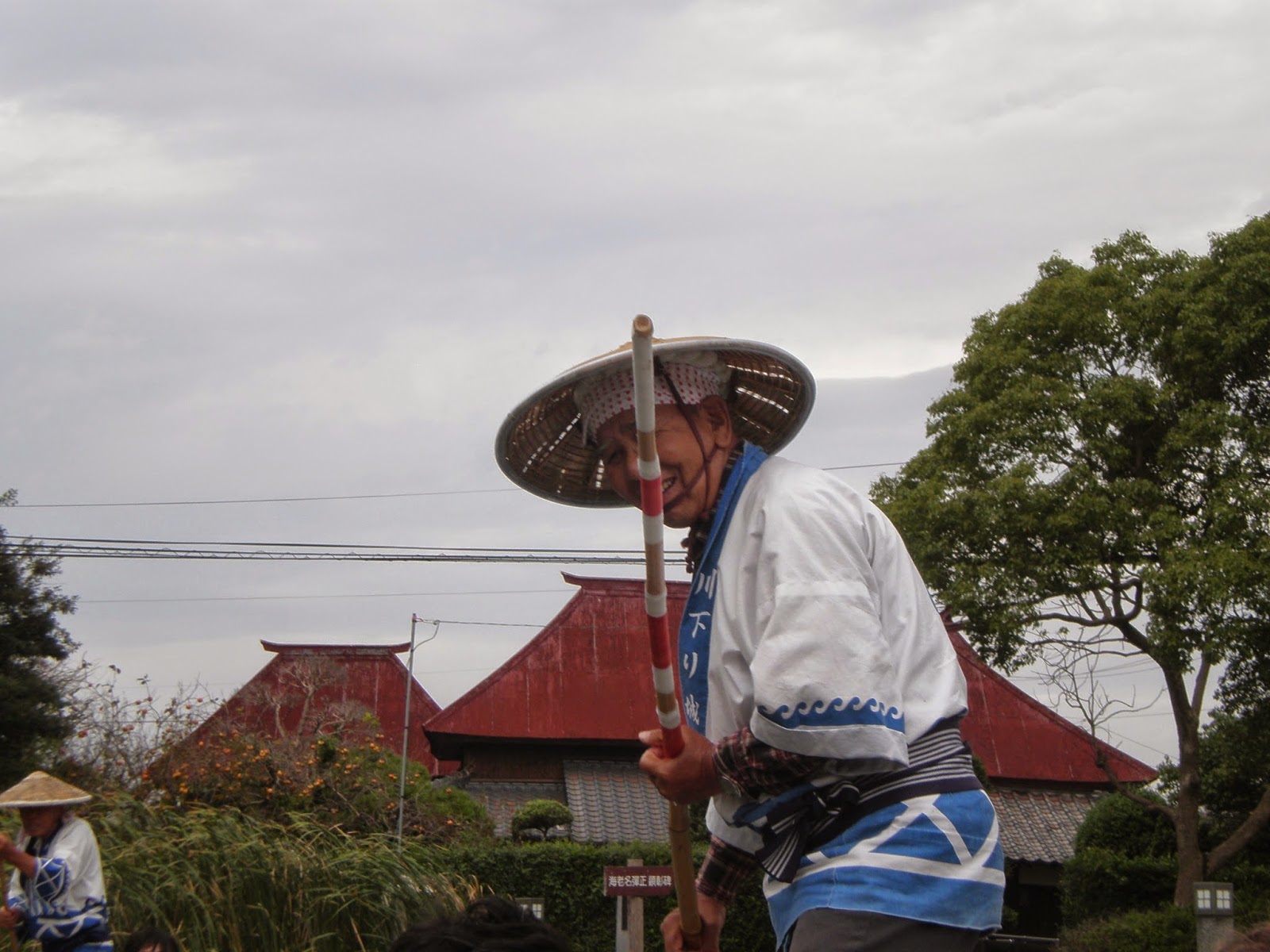
Our lunch was rendered complicated by a few factors. One was that it was raining on and off, so that we regularly had to put umbrellas up and down - the hardy singing boatman just had a large hat. Pleasingly, these hats are called 傘 (kasa) in Japanese, which is the same word as umbrella.

Not surprisingly, there were also many bridges to navigate; these were universally low and narrow. The boatman (with some help from us) got us through these by hauling ropes on the ceiling, as it was impossible to pole through here. There were rather a lot of collisions associated with these bridges, though, especially when there were other boats coming through. None were particularly heavy, but it wasn't the sort of smooth, slalom-running image you tend to be given of gondoliering. At one bridge we ended up waiting for about five boats to pass us from various directions, at one point getting halfway through before an opponent shot through in the opposite direction and we were forced to pull back.

Honestly though, the biggest problem was room. Being Japanese, the idea was that you kneel at a low table in the centre of the boat - no sitting down here. This was possibly fine for people used to kneeling for long periods (like I said, two hours), although I believe even many Japanese people don't do it that regularly now. Alternatively, you could sit cross-legged or fold your legs like a lady on a horse. However, the table was very low, and it turned out that none of these methods were really designed for foreigners nearly 6' tall with no particular yoga skill. Sitting cross-legged I take up a huge amount of room sideways, which wasn't a great option, and couldn't really fold my knees low enough to get under the table anyway. I ended up kneeling for a bit and then adopting a kind of inelegant sprawl. With regular shifting I was just about able to stand and walk when we finally arrived, but it was looking pretty touch and go!

The food was decent, although I didn't eat a huge amount, and I really enjoyed chatting to an array of new people in various languages (he says, smugly). There was also an unexpected matchmaking attempt, which I dealt with with my usual grace and charm - which is to say, making a nondescript remark and then pouring some more drinks. Apparently I exude some pheromone which inspires this sort of thing?

We also discovered that Yanagawa is absolutely full of spiders, which hung in vast webs in the gardens all along the riverbank. This is not a trip for the arachnophobic.

For anyone bemused by discussion of feeling singled out for attention on the part of ethnic minority folks, I can heartily recommend taking a boat trip through Yanagawa with a large group of white people as a safe, friendly introduction to the notion. We were greeted enthusiastically by every passing boat, called to in English, waved at, and photographed exhaustively by boaters and passers by. Several people hung over the riverside to watch us, and at least one car actually stopped so the family inside could lean through the windows to see. There was some wry discussion on our boat as to whether a notice of a Gaijin Boat Parade had been placed in the paper, and so on and so forth. All of the attention was, of course, entirely friendly and well-intentioned, and having a certain amount of experience of this before I wasn't particularly bothered by it. However, after a while it does feel like an interruption to your social event having to constantly respond to this, and some people seemed a bit irked by the attention. Most other ethnic groups should be so lucky.

The Festival

秋季大祭「おにぎえ」 (Shuuki Taisai Onigie: Autumn "Onigie" Festival)

Apparently, the name derives from a word related to noisiness, clamour or being throng with people.

Anyway, we finally arrived and I disembarked cautiously. Some people were pretty vigorous about springing from the boat, and there had been quite a lot of standing up to take photos - rather alarming for me. I think the boats were rather wider and heftier than what I'm used to and more robust in surviving that kind of behaviour. After standing around for a while, we were led down the road to some park where various floats had been assembled. We were given colourful cloths, and shown various ways to attach them.

At this link here you can see videos of each of the floats - taken before the festival, so no crowds getting in the way, and no me either.

We then were shown around a bit, and I learned that "opportunity to participate in the festival" actually meant "you will pull this float across the city".

Some folks not quite wearing their happi coats, making preparations.
One of the many festival food stalls - we had no time to actually explore the festival. This seems like a bit of an oversight to be honest. Perhaps the boat trip could have been a tad briefer and given us time to look around?

Festival floats ready to be carried to the shrine.

The float we would pull was occupied by some local maiko (trainee geishas) and geishas. Various folks posed for pictures with them, and some were lent festival happi coats to wear. There was some very excited announging of everyone's home countries, with fist-pumping and shouting - I believe this kind of psyching up is more widespread in Japanese culture than I'm used to. Thankfully there was little waiting around and we soon set off hauling the float down the road.

I couldn't take many photos due to, well, pulling a float, but it turns out there are some videos up already. this one features us setting out from the field - I actually appear about 8.30, not yet attached to a rope and looking extremely portly for some reason. And here we are getting the float over a bridge.

Maiko, geishas and a small boy of unknown purpose waiting in their float. This is the one we pulled.

This probably isn't a weathercock. It's the top pole from one of the floats. Each one is undoubtedly riddled with significance that I'm ignorant of.

These three floats each feature people dressed as oni (evil spirits). They were doing some vague acting, with some background music, which eventually gave the impression that they were being conquered as they entered the shrine.

Search me.

This person has a red mask with a huge nose and a long wig. I'm sure they represent something important.

Now, small children dressing up is something we can all sympathise with.

These ladies almost certainly do not represent the healing powers of mushrooms, but that's as far as I'm prepared to go.

A portable shrine. This mini-shrine is being carried to the bigger shrine, which creates a kind of Russian doll situation. Actually most shrines have multiple sub-shrines within the site, some very small and others huge.

A man on a horse. Of that, we can be sure.

Ah, this is a bit more familiar. This is us lot lining up to carry the shrine.

Carrying in progress. There was a modest amount of people lining up along the streets, but most were narrow enough that there wasn't lots of room for a big crowd. However, it was a pretty long route so I don't imagine it was a problem.

It wasn't particularly tough due to the number of people involved; the locals hauling the float body had a tougher time of it than those of us on the ropes, as they also had to handle braking. And there was a lot of braking, because the whole convoy kept stopping and starting at various bottlenecks, from crossroads to bridges. The logistically-inclined part of me tut-tutted at various things, like the rather inefficient pulling of our amateur group and overall speed management, but it's all a bit of fun. The geishas kept up a constant traditional drum rhythm, pausing occasionally to shout "onigie" and other things; it was all a bit hypnotic. I felt quite sorry for them actually, maintaining the beat all that time.

Aside from some minor chafing on the hands, a great thirst, and rather tired legs, I came out okay. Negotiating narrow streets with occasional traffic was a problem, and there were a couple of minor collisions with scenery, plus one traffic mirror had a nasty accident. On the whole, though, we did surprisingly well and eventually made it to the shrine. Here the float was parked and everyone stood around for quite a long time while nothing in particular happened. I'm sure it made sense to somebody, but not anyone I talked to!

Shrine parking.

Not our float, but another maiko float. The middle maiko here seemed rather dissatisfied with proceedings throughout. At this point, though, they'd been carried all through town playing the drums, then hanging around at the shrine for about half an hour. I imagine their knees were pretty painful. Maybe she was just really keen to get down and stretch.

Little shrine being carried into big shrine.

Donor acknowledgements outside the shrine.

Super wedding bonus round

Around this time we were due to be picked up by coach and returned to the station for a 4pm return to Fukuoka. However, there was a sudden announcement that the coach would come later, due to the area being very crowded. Instead we would go and watch part of a wedding. River weddings are traditional in Yanagawa, apparently, with the bridal party processing off down the river in various boats, and as luck would have it our guides had just learned that one was happening right out of the temple where we stood. Much to the surprise of us Europeans, the family had said they were quite happy for a gang of random foreigners to come and gawk at them and take photos. So we stood along the riverbank. Obviously we were trying not to be intrusive, and so photo opportunities were limited, but it was a nice bonus opportunity.

The wedding party

Some keen-eyed readers may spot some discrepancies. This appears to be another couple who were marrying at the same time! One boat headed in each direction, and this was the one that came my way.

Our lot milling around at the wedding.

Unfortunately, the bus was a bit of a problem because I'd agreed to meet someone immediately on return to Fukuoka. Previous experience was that public transport was reliable and we'd be back on time, so the sudden delay was a bit of an upset to plans for various people. We scrambled to try and contact people, but at least in my case I didn't manage it, which was quite embarrassing.

I'm not entirely sure what the eventual plan was. Some people were going back to another shrine for a while, which according to rumour might have been another couple of hours. We convinced Ishibashi-san that we needed to get back, so us early birds were dropped off at the station before the others headed off. I eventually returned at 5pm, by which time my friend had understandably left. So that was a bit of an unfortunate ending to the day.

Afterthoughts

Linguistically it was an interesting day. I had to be regularly asked to slow down when speaking English, which was mildly embarrassing. Only a small proportion of the GenkiJACS students are native English speakers, though most have very good English; this tends to mean most people share a similar kind of second-language-speaker accent, especially as virtually all of those are European and the majority from Germanic-speaking countries. The native accents of Albion are a bit puzzling to most. I was also quizzed on whether I was half-German (no), a point which has come up several times recently. Apparently my German is good enough to more than once pass muster as "some kind of German dialect from some country other than mine" in brief conversation, which is deeply flattering. I have been making the effort to speak it a lot while I'm surrounded by German speakers, it's nice to have the chance.

I must admit I also like the air of mystery, since people are fairly often puzzled by my combination of unrecognisable name and uncertain linguistic background. Since everyone here speaks some English, my accent gets very weird in a mixed-language environment, and mostly we speak Japanese, there are limited clues as to where I come from until it inevitably comes up in a conversation exercise. Obviously, some people just ask.

The festival was fine, and the boat trip also interesting, although if I'd gone with just a couple of friends I suspect it would be much longer than I wanted to spent out of my trip. There's a half-hour version available, apparently. It seemed like it might be nice to have a stroll through the town, but equally I didn't see any particularly striking places. I'd want to do more research before deciding it was definitely worth a visit.

Some nice leaves. I just liked that one, and only one, was yellow.

Saturday, 11 October 2014

End-of-book exams

This is mostly for GenkiJACS students, so feel free to pass along if that isn't you. I should also mention that this will not include any specifics of the exam, since I'm pretty sure they will need to reuse some questions. Not like I could remember them now anyway. In case anyone's confused, I wrote most of this on the day of the exam, but didn't finish it up until a week or so later.


So having finished the Genki II textbook, I'm due to take an exam (in about an hour) before I can move on to the next class. I thought I was done with exams ten years ago. For what it's worth, I'm writing this in a brief revision break, not purely for procrastination.

I was under the impression the exam would be once my lessons resumed next week, as I'm currently on a 3-week half-term break. However, while I was in Korea I had an email asking me to take the exam today. If I'd arranged another trip or something I'd have politely declined, but since I wasn't actually doing anything I didn't see any particular excuse. It also meant, although I'd have to cram my revision in, I'd have a few days post-exam when I wasn't thinking about it. And in the fairly likely event that I don't pass, it gives me more time to prepare for another go...

The exam covers the whole textbook, covers vocabulary, grammar and listening, and has a pass mark of 80%. I haven't actually studied the whole book in class, due to joining an ongoing class on the basement of my placement, which means that although I'd covered the essential bits, there was quite a lot of vocabulary and a certain amount of grammar that I hadn't covered. So I've been trying to catch up on that in my free time during the past couple of months, while staying on top of my classwork and homework. I just about got there.

Unfortunately there's no past paper for the exam. As someone whose revision style is based almost exclusively on doing past papers, this is a pretty substantial drawback.

I now realise that one thing I should have done ages ago is make use of the accompanying CD. Because we'd been using it in class sometimes, and covered the other sections with the teacher, I didn't particularly see the point. So I only started using it yesterday, and realised I'd been missing a trick.

The advantage here is that the CD is both a resource for listening (which you really can't get too much practice for, especially for the odder verb forms that get less use in conversation) and a way to drill things. So I started working through the textbook exercises based on the CD. I just wish I'd had longer to do this. I heartily recommend any future students to do exactly this. On a weekend or something, just pick a chapter and go through it. It's great revision and pretty quick when you're not doing anything else. Doing it in small doses over time will be way more effective than trying to cram it in like I am.

Right, back to revision.


...time passes...


Okay, I just finished. Maybe. We'll get back to that in a minute...

The exam was, on the whole, okay, although I'm not hugely confident.

My exam (they presumably differ) came in more that one paper. As nobody else was taking it at the time, I was set in a room to get on with it. GenkiJACS clearly trusted me not to do something as self-sabotaging as cheating on a progression test, so I just dumped my bag in the room and started - none of the regulatory stuff you have to worry about in school most exams, no teacher sat impatiently waiting for me to finish à la GCSEs. This was an unexpected and very welcome feature. I began with a grammar paper, which covered everything from verb inflections to particle use, including some contextual use. Opening the paper, I look at a table of verb forms and promptly transformed into a shaking, sweating mass of nerves.

This was pretty unexpected, because historically I haven't really been that worried about exams that didn't involve oral tests (those are always deeply traumatic). However, in the last few years I've had some stress/anxiety issues, and they decided to manifest here. This may be partly because I didn't get as much preparation done as I'd have liked, as I mentioned, so I wasn't feeling entirely ready for it. The immediate reason was that this was actually one of the trickiest parts of the whole test for me. You know where I mentioned earlier that I'd missed some of the textbook by joining an ongoing class? Well, that included a couple of verb forms in their entirety - the potential (can do) and volitional (let's do) forms.

I did say I wouldn't mention specifics, but I feel like "you need to know all the inflections of common verbs" is obvious enough that it doesn't really undermine the test in any way.

Naturally I'd looked over these forms in my revision, and we did use them a very small amount in class. However, they aren't used that often in a classroom context. When they are used, we tend to be use the -masu polite form of the verb, whereas the test covered the plain forms used between friends. I use the volitional occasionally in conversation with friends, but of course in that context it's much easier to get away with mistakes, particularly small ones like slight mistakes in vowel use. The test was written, of course, and so accuracy was crucial. My revision had been hasty, with a lot of vocabulary to focus on, and I was filled with agonising doubt about the details of these forms.

I spent around fifteen minutes of the fifty available filling in the first question on the test, and then moved on. Most of the rest seemed okay, with a few uncertain points. I left a couple of blanks, because in a test like this I saw no point in guessing when I didn't have a preferred answer. If my Japanese wasn't strong enough and I needed to redo some material, then I'd be better off failing than passing by chance. What with my worries about the first question and having wasted a lot of time, I was fairly stressed throughout this paper, which naturally slowed me down further, so I just scraped a finish before the time was up. Quite worried about this paper, I had no time to review answers or anything. As a person who normally spends the last third of all exams rereading the paper twice and then doodling in the margins, this is a pretty big deal.

Thankfully, the rest of the paper was nothing like as anxiety-inducing as the first part, and between that and a brief break while I got a fresh cuppa (yes, I could drink and eat during the exam! marvellous!) and the next paper, and my brief conversation with the lovely Nabe-sensei, I'd calmed down a fair bit.

The second paper was vocabulary. This included kanji recognition, marking pronunciation, and knowledge of how to use words in a sentence. It was tricky in places, not least because some kanji are annoyingly similar to others. This is a particular problem for me because I know a ton of kanji that haven't yet appeared in the books, including loads that I only know in Chinese and may have a wildly different meaning or pronunciation in Japanese. While it's usually a big advantage for me, in some types of questions this can trip you up. On the whole though, I found this paper fairly straightforward, although again there were a few spots I wasn't that sure of. Not entirely sure how well I did, as I was a bit doubtful of some points (especially pronunciation) but probably better than the grammar.

When I finished paper two, I came out and there was some brief confusion. It wasn't quite clear whether I needed to do a third paper, and as it was getting late, nobody left in the office knew the answer. There was a paper lying around, but it wasn't clear whether it was intended for me - from a quick look at it I rather thought not. So I agreed to come in the next morning and check.


...the night passes uneventfully...


So I went into the school again and discovered I had in fact finished the exam. In fact, Nabe-sensei had already marked it and congratulated me on passing! I was so happy. Exact marks and transcript aren't ready yet but knowing I can progress (and don't have to resit!) is good enough for me right now. This afternoon is my conversation date, so I can also enjoy that without having exam worries in the back of my mind.


...the next day...


So I came into school for no particular reason. It's technically still holiday for me, but I had nothing particular to do and I get bored sitting around my apartment or just walking on my own. I've done plenty of that. So just like on my free afternoons, I decided to spend a few hours in the lounge reading and studying. Being at school generally makes it easier to motivate myself to work, plus I like having people around even if I'm not chatting to them.

Anyway, Nabe-sensei tracked me down and provided me with my transcript. The boy done good!

Okay, this will be a bit bewildering to the non-Japanese-readers amongst you. The broken part on the far left is just my name. From left to right, we go Vocabulary, Grammar, Listening Comprehension, Interview, Total. Each lists a number of marks (点) available. Each section has two boxes, for mark and percentage respectively. The Listening and Interview sections are blank because they're for higher-level students, I think. As you can see, I actually did better on the gramamr than on the vocabulary! I'm not quite sure how that happened, but then it was a much bigger paper.

I appreciate reading the picture may be difficult. The crucial point to note is that with a pass mark of 80%, I scored a respectable 91% overall (89% vocabulary, 93% grammar). I'm fairly happy with that.

I was allowed to see my papers and check the mistakes I made, but not to keep them. Seems fair enough, presumably it will help avoid answers getting passed around - with the best will in the world, for many people it would be hard to say no if someone asked for a look at your paper, and people won't necessarily realise that answers may be the same.

Unfortunately I didn't think to actually write down the points I need to review. I might ask in the office if they can let me have another look so I can do that.

Sunday, 5 October 2014

Kiwi rice and spiced beef

Having eaten quite a bit of plum rice recently (it's the most appealing meal sold by the corner shop) it occurred to me that rice with kiwi fruit might be an interesting choice. It would lend a tart sweetness to the rice, rather like plum does, although it would need to be added at a late stage, because boiling kiwi for an hour would destroy it.

After much thought, I went for kiwi rice with spiced beef and green pepper. I carefully did this in separate bowls (normally I'm lazy) so as to keep the three (sweet, hot and bitter) as distinct as possible.

I peeled the kiwi (I use a potato peeler, but a knife works too) and just diced it into 1cm chunks. As I was using a rice cooker, I added the kiwi about five minutes before the rice was ready, stirring it in before popping the pot back in.

The rice was, as I hoped, imbued with a slight sweetness and a fruity hint that leavened its bland taste. It also contrasted pleasantly with the beansprouts and pepper. However, I was disappointed with the beef. I'd hoped for a nice strong flavour with a spicy kick, something rich to offset the rice. In fact, it had a very mild flavour and so didn't provide the contast I'd hoped for. It's fairly difficult to work out exactly what I'm buying in the supermarket, so I'm not sure I can hope for much better. Bacon might work? I dunno.