Showing posts with label Kumamoto. Show all posts

Saturday, 22 November 2014

Housematery

So recently one of my favourite humans managed to find the time to pop over to Japan for a week. That would be my old housemate, SC. We'd been talking about it for months, so it was brilliant to see it coming together.

As it worked out, SC basically spend some time with me at the weekends either side, and then shipped up to Kyoto during the week while I was at school. I kind of wish I'd been able to go to, but I really need to maximise my study time while I'm here. This is especially true because I'd missed several days due to illness just before she arrived, and wasn't on good form for a while afterwards. So I'd fallen behind, and honestly I'm still struggling to catch up.

The first night, all we managed was to meet up and eat. After strolling around for a while looking for promising places where I could understand the menu, we picked up some food from a tiny restaurant in Tenjin, and went to this place. It's a financial services building with a cafe outside, but everything was closed by, oh, 8.30pm or whenever we went. So we sat outside in the cool darkness, talking about stuff and eating chicken with curry sauce and rice. It was really nice. The only downside was, as ever, the lack of bins! I ended up taking the remnants awkwardly home on the train, which is a bit of a hassle when it's pots half-full of curry sauce and bones, even when you have a bag for them. Thankfully no leaking occurred.

Temples Galore

The next day we met up near Hakata station, and went a-templing. We wandered up to Shoufuku-ji, the first Zen temple in Japan. It was great. It's a large, very calm, very tranquil place (at least, when we visited!) and after wandering around for a while, we sat and talked on the steps of the main hall. There was nobody around for us to inconvenience, after all.

After that, we proceeded up the street and bumped into Touchou-ji,, the oldest Shingon temple in Japan. Here we pondered the very orange tower, and admired the very impressive inner hall, although neither of us is in a position to appreciate the significance of what we saw.

Since we were running short of time, we returned to Hakata station and discovered the array of shops and restaurants in the huge tower above it. Not something I'm used to - our stations are pretty much two-dimensional. We ate at an Okinawan restaurant, which was mildly bittersweet from my perspective, but the food was good. Then we parted ways for the week.

Kumamoto II: the Return

The following weekend SC came straight down to Kumamoto, and we arranged to meet there. Having already been once, I was in a position to act as guide and show us around. The weather was far nicer than the first time I'd been, and having company was also a lovely change for my tourism experiences, so all in all I had a great time. We saw the castle first, and it was very pleasant.

I have no idea what this is for. Possibly some form of sundail, or a crude compass?

I was delighted to see that the costume performance was happening that day. On my previous visit it had been rained off, but here we were able to get a good spot and watch, although I didn't understand much. The Japanese used seemed a bit old-fashioned (fitting the personas) and mostly seemed to consist of very long sentences that didn't contain much information. But the dancing was fun:

We took a break in the castle to eat some mochi, which SC had been given by a girl she met on route. She seems to have befriended roughly half the population of Kyoto over the course of a week, which doesn't unduly surprise me.

They were delicious, and with that very healthy lunch we pushed on through the Hosokawa place. It doesn't take that long if you're not trying to fill your day, so we were able to cram it in quickly. Although we discovered SC had managed to lose her ticket while walking around the castle, the Hosokawa staff very kindly let her in on the grounds that I had mine (probably guessing it was unlikely we'd randomly met in Kumamoto, and thus we'd presumably both bought castle tickets).

Afterwards we ate ramen in a nice little place, and then went for coffee.

One of the odd little events that holidays get you cropped up when we were getting our coffees. SC spotted a crowd with a van on a corner, and asked me to explain. I worked out that it was one of the many campaigning vans going around recently, this one belonging to Ishihara Yasanari, a candidate for mayor. While I can't quite make out the details of his policies, such crowd-pleasers as "town planning that each individual can be shining symbiosis", "school volunteer grandparents region take advantage of the good technique" and "I want to be able to take the city hall staff test in immediately towards the blind" explain the riotous reception he received. And we can all surely agree that "women are cheerful town, full of full of energy", can we not? As customary, the van was deafeningly loud and probably quite annoying for most of the local shops.

There was also a bit of singing with a rather talented lady; as far as we could tell she just turned up, sang on top of a van and then took her family off home, so I'm not sure whether she was a planned part of the performance, or simply decided it would be a lark and everyone was too polite to stop her...

It hadn't occurred to me that this would be fascinating, but as SC pointed out, an election hustings is a real novelty if they don't really bother with things like democracy or attracting the popular vote in your country. It was one of those teachable moments for me.

Back to Fukuoka

Due to various events going on, Fukuoka was pretty much full to the gills that weekend, and we'd been worrying about where she could stay. However, a friend of mine very kindly stepped in and offered to let SC sleep at her place overnight! Considering they'd never met and I've only known my friend a few months, this was amazing. もう一度ありがとうございました!

We reluctantly took up the offer when nothing else seemed available, short of helping her find a room in a love hotel (probably embarrassing, but a good anecdote for parties!). There was a fair bit of stress with the arrangements, as we were a bit late coming back from Kumamoto, and then had to take locate and take a Japanese bus (for the first time) while texting rapidly in Japanese (also for the first time). In the end we made it, and duly met up, laden with omiyage to thank my friend for this enormous favour. The next morning I called round to pick SC up, and was invited in to meet the family. This was another first, as I've never been in a Japanese home before. It was really lovely, sipping ultra-posh Fortnum and Masons' Orange Pekoe and chatting away. As far as I can tell, I managed not to do anything particularly impolite, which was a relief.

We left after an hour or so, and headed to Ohori Park for a bit of exercise. My friend had explained that there was a traditional Japanese garden there, which I'd always assumed was a temple and so not bothered visiting (I've seen a lot of temples, and I go there for the park). This proved to be another very tranquil place, and we wandered round for ages talking about jobs and politics. Ah, the exciting life of a 30-year-old! Then we picked up something to eat and drink from the cafe, and headed to the airport.

After a certain amount of confusion, SC managed to check in. Meanwhile I was accosted by a lady doing surveys, but we eventually managed to establish that SC, rather than I, should be doing it. A complex trilingual conversation ensued, since the lady turned out to be Chinese. Officially I can speak Chinese, but in this case it was much easier for me to use Japanese most of the time. That added a bit of extra interest to the trip.

And then it was time, and I said my very reluctant goodbyes and headed back home. It was lovely to see an old friend for the first time in months, and I spoke the most English I have since the summer. While I have got to know some very nice people here, and had a lot of fun, it's a different thing from from hanging out with a long-term, comfortable friend and just chewing the fat over ordinary stuff.

Come back soon!

Friday, 19 September 2014

Mooching in Kyushu: Kumamoto 2

Due to my headache and nap last night, today begins with my oversleeping , so I miss breakfast. Thankfully I was prepared for this, or other food-related emergencies, so I brought a couple of small cakes along for emergency rations. As I eat my breakfast, I get a call on the internal telephone. It's a bit baffling, but I eventually answer it. Turns out the staff at reception are calling to tell me I've overstayed checkout. This is distinctly odd as I booked for two nights, and I definitely heard the lady who booked my room at the station say "two nights" and give the dates; she also wrote that down for me with the hotel's address. I go down to talk about it, discover that although the station staff said two nights they only booked me for one, and pay for another night.

A few minutes later, someone else calls me to once again tell me I've overstayed. Sigh. This is my cue to leave.

Today's itinerary is the Hosokawa Gyobutei, followed by Kumamoto Castle. I decided to do them in that order because the mansion should only take a little while, which is as long as I want to spend before lunch. Also, I'm sure I can use up as much time as I want in the castle just by looking at more bits of castle, while the mansion will be fairly limited in that sense. Plus, I hold out hope that it might stop raining by this afternoon (spoiler: it doesn't).

Hosokawa Gyobutei

The residence turns out to be at the far side of the castle grounds. I wonder for a while whether I've done this inefficiently, but it will later turn out that there wasn't a neat option. It's a compound of elegant, low walls and only one building reaches two storeys. The Japanese concept of an aristocrat's home is very different! I have a quick wander around the outside, but they don't really seem to go in for massive gardens like the British did, so in I go.

Most of the grounds consist of gravel, raked into even lines. I presume they don't need to do it often, but it still looks like a right pain! Perhaps less than mowing the lawn, though. I also notice that, unlike British gardens, they tend to encourage moss and use it as a feature, not an enemy. A lot of the lawn-looking areas are actually swathes of moss.

The house was originally in the castle grounds, but in 1871 the castle became the region's military headquarters, and all resident samurai had to move out. The house was reconstructed a little outside the castle walls.

It's only a few quid to get a double-entry ticket for both the mansion and the castle, so naturally I take that option. The mansion seems very quiet, with only a few visitors. I wonder whether the proximity to the castle hurts it? Technically, there isn't a huge amount to see, at least for someone like me who isn't versed in Japanese history and architecture (and can't read much Japanese). I'd probably get more stuff out of seeing a British country house. This is interesting though, because it's only the second Japanese house I've seen. It seems mazelike, and I very quickly have no idea where I am despite the little map. An intricate route is traced through the rooms, and most of the walls seem to consist of sliding panels.

Apologies, but all these photos were taken without flash, and so the quality ends up not being brilliant. Not that my usual camera-work is much to boast of.

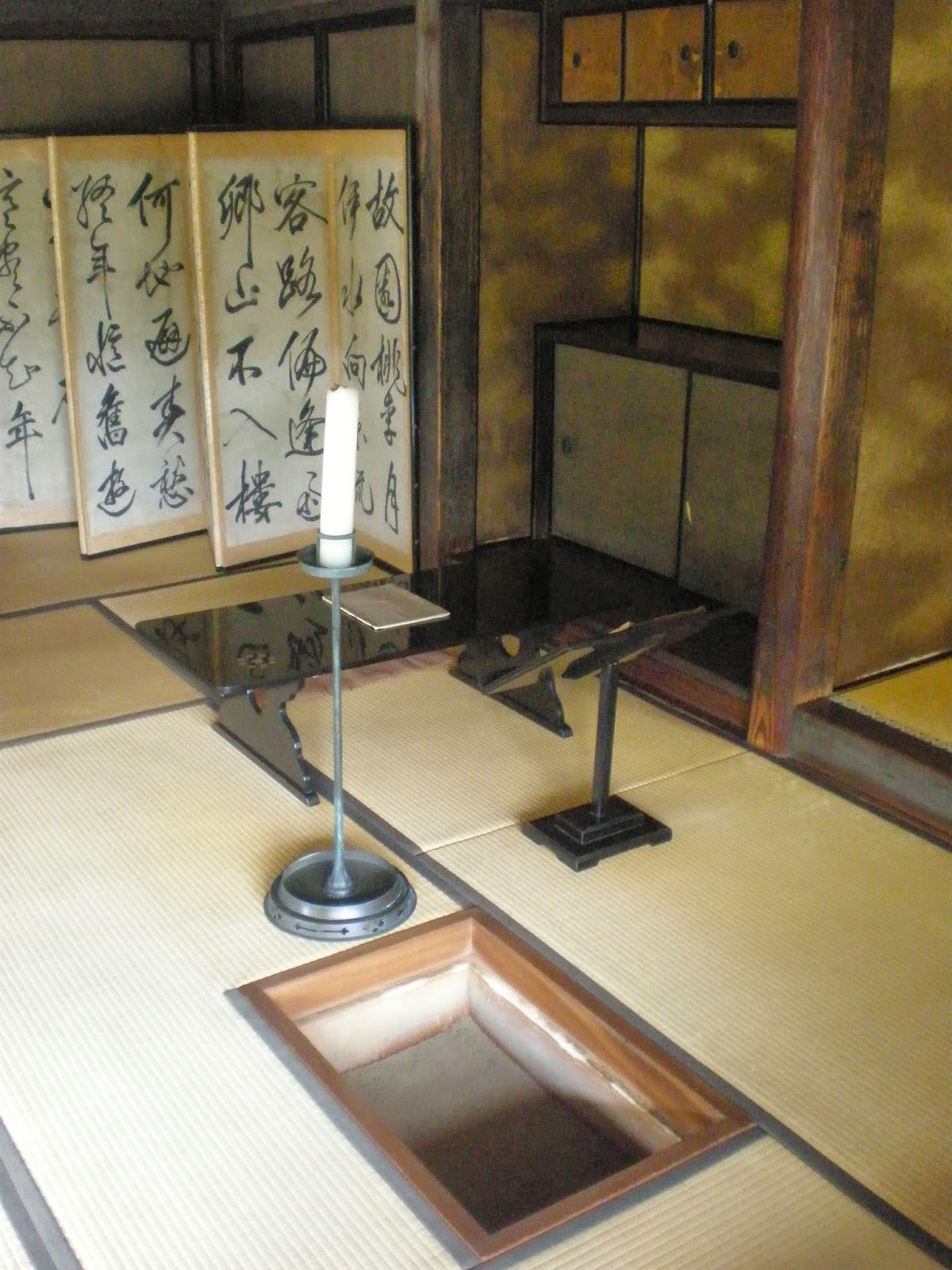
The hole in the floor is full of sand, and was apparently used as a fireplace. I can see a brazier could be brought in to keep the place warm in winter, with minimal risk. Obviously with a house built of wood and paper, having a Western-style fireplace would be problematic. Also quite dirty.

Sadly, you couldn't go in the kitchen. Seeing the rooms where things actually happened is one of my favourite things about looking around houses, and unlike toffs, servants can't decide to adopt an austere aesthetic and stop having physical objects, because they still have to do some actual work, which requires stuff. I'd have liked to see what was in there and compare it to Western country house kitchens.

A chest of stairs. This leads up to the first floor, which sadly is also off-limits. I have no idea what was up there.

Because the house is mostly one block, some parts seem very dark, even with a lot of outside shutters open to let the daylight in. I wonder what it was like living in there. There's very little furniture or possessions here, but it's very hard to tell how authentic that is. There is a general perception that Japanese people have a simpler lifestyle with less stuff, or at least that they did at some ill-defined point in history. But was that true, or did they just not keep as much stuff over time, or have lots of quite ephemeral possessions? This house didn't showcase anything like clothes, utensils, or such necessities, so certainly something was missing, I just can't tell how much.

On the other hand, I'm fairly confident they had much less stuff than the average Victorian nobility, because the fashion seems to have been simplicity rather than knickknacks, and because traditional Japanese houses don't use nearly as much fixed furniture. If you don't have fixed furniture, you're not going to have as much stuff lying around on it. They have cupboards and things of course, but mostly built discreetly into the wall.

Obligatory food section

Having looked around the mansion for a while and feeling rather jealous of it, I decide I should grab some lunch. Or at least a drink and a snack; if need be I can make do with that until tea time, as I had a late breakfast. Sadly, the lady on reception tells me there's no cafe, restaurant or anything like that anywhere nearby. I confess some bafflement. Raised as I am on National Trust properties, the idea of having not one, but two impressive historical residences without arranging some tea and cake premises nearby seems bizarre. The closest thing I can find is, in fact, right back by the castle entrance. Since those seem both pricey and difficult to comprehend for this foreigner, I walk a little further to the outskirts of town, and find a convenient restaurant that will give me udon and orange juice. The juice takes a bizarrely long time to arrive (about 20 minutes after the food) but all is fine and fairly cheap.

Apparently the pink thing is a slice of kamaboko. This is reconstituted fish, with various additives, and added colouring, which is baked into a loaf and then sliced. It was a bit rubbery but not unpleasant. They also add bits of tempura batter, which as far as I'm concerned are indistinguishable from soggy rice krispies, but each to their own.

Refreshed and reinvigorated, it's time to march back up the hill to the castle.

Fukuoka-jo

Being a proper castle, it's quite hard to get in, requiring a lot of walking up hills and around massive walls.

The bit where it is physically discouraging is quite effective, I find. 8/10, would Not Invade Again.

The upper rampart looks very nautical to my eyes.

This here is the main tower and one of its adjoining turrets. I think it's quite attractive.

Just try scrambling up that, that's all I'm saying (don't, though, because there's a notice forbidding it). Includes tourist for scale.

This section shows where an older wall (the right section) was adapted a couple of hundred years later, with a new steeper layer added to the wall. It looks pretty weird in practice because of how the corner works out, so the wall has two distinct corners in the same place even though the top of the wall merges together.

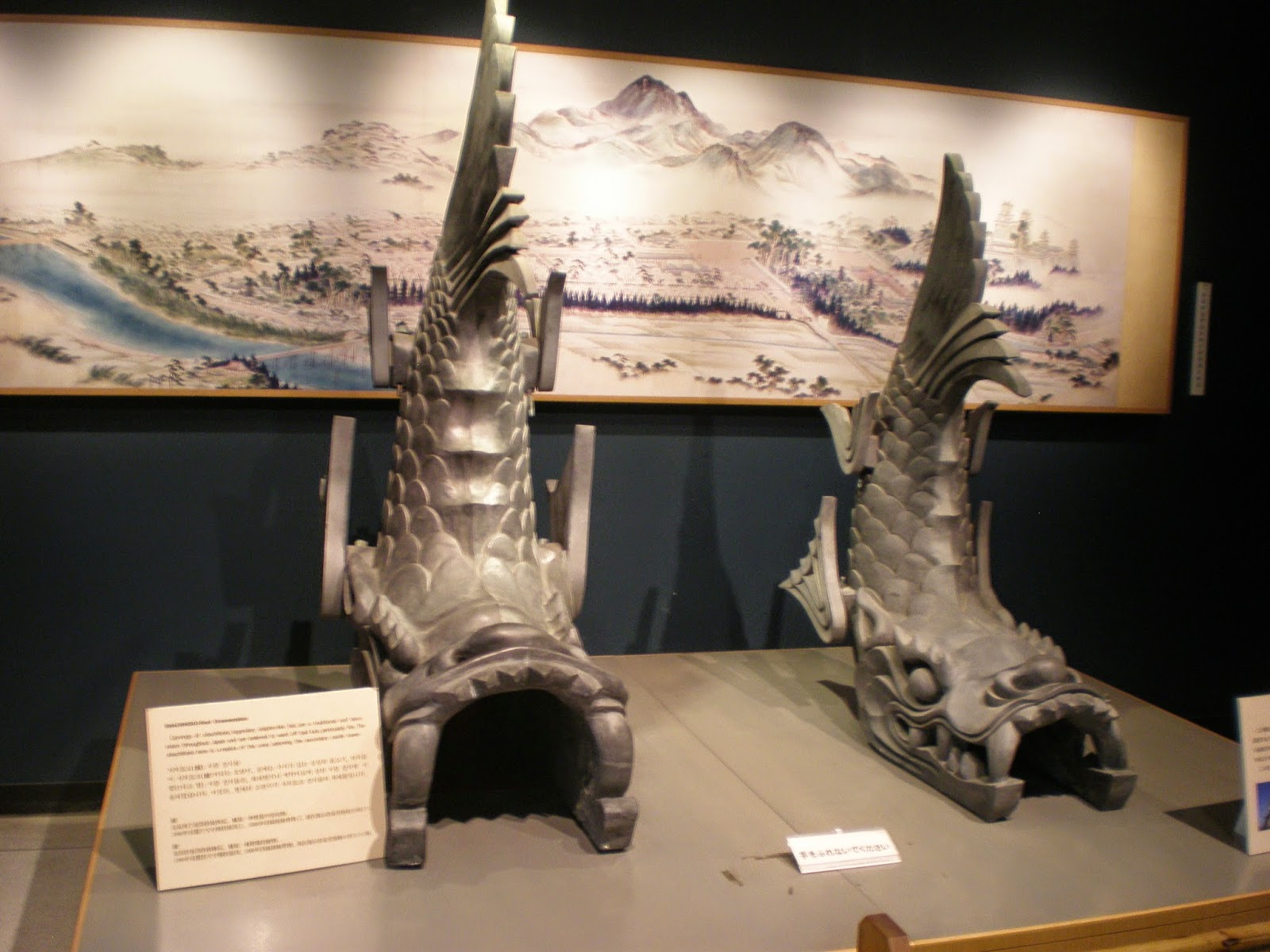
I was puzzled by this informative notice, because it discusses the size of dolphins. Is this a strange translation issue? Is "dolphin" an architectural feature of which I was unaware?

Oh, right. Glad to have that cleared up. These are special roof tiles added to the ridge, depicting mythical fish-beasts (which they're translating as "dolphin") believed to help ward off disasters, especially fire. It clearly didn't work in this case, as almost the entire castle was obliterated by fire in 1877, including the buildings with those dolphins. Only the stone parts remained. About one-third has been rebuilt from the 1990s. There was an interesting video about that, showing some of the building work and individual bits of craft required.

There are some lovely models of the castle in various places, depicting those particular buildings, but I just went for a photo of this, which shows an approximate recreation of the historic castle and town.

This impressive mock-up is inside the real version of itself.

Some of the many, many hills ringing Kumamoto. Most elegant. Reminds me rather of the Lake District (yes, I know, very parochial of me, but it does).

Inside the topmost "penthouse" (as they call it) of the main tower. I still find it strange to think that palaces in Japan in the late 19th century had to serve as genuine military fortifications. It's hard to shake off that British viewpoint of not having had a civil war in several hundred years. This would have been a sort of observation post-cum-command centre rather than a cosy penthouse suite, although from one of the mock-ups it seems like they would actually have kitted it out more comfortably than this! A lot of the tower rooms aren't rebuilt to suit their original purpose, but just as general rooms or for tourist purposes.

The view from the top. In reality there were probably more buildings between the walls, but they didn't survive. I suspect this is partly why so many castles and things seem elegant and spacious these days - we don't see the rickety wooden buildings that disappeared once the toffs stopped paying upkeep on castles.

Katō Kiyomasa, who had most of this castle built, apparently wasn't just some soldier despite living in the 16th century. He also had a lot of improvements done in his domain, such as this plan for better irrigation of the farms. The stone objects shown here would help prevent silting by altering the flow of water - you'd have to ask my brother for the details.

This is an umbrella park. Little clamps lock the umbrellas in place and a key comes out that you can use to retrieve it later. Not a bad idea.

I have very few photos of the grand hall, because it would be hard to take any that make it as impressive as it should be. It's a series of drawing-room sized, rush-matted rooms with very simple furniture. Because it's a reconstruction, most of the decoration is still missing, so the walls are basically bare wood and paper. It's the cumulative effect of all these rooms, the expensive mats, the expensive bits of decoration here and there, that would overawe a visitor. They would move through a series of chambers that got gradually more ornate and more expensive, mostly shown in things like furniture (missing), the stylishness of the samurai sitting there (missing) and the gorgeous artwork covering the walls (missing). There's no way to recreate that effect with photos of some small IKEA-looking rooms, even though in person you still got some sense of it. To a person of the time, I'm sure it would have been very striking. The whole place used over 1000 tatami mats, whereas an average room even nowadays is six mat-measurements and I suspect many middle-class houses were only that big.

But I did take this photo of the fireplace! It looks deeply inconvenient. The idea of trying to lean over the firepit and heave out a heavy iron kettle is deeply unpleasant. You'd do your back in. I tried to ask one of the staff how it would be done, wondering if they had some kind of special tool (maybe a small crane?) but I didn't quite have the vocabulary and she started moving into Emergency Shutdown Embarrassment Mode, so I apologised and gave up.

I didn't entirely miss out though, because the one thing they have fully recreated is the daimyo's (lord's) primary audience chamber, the most formal place in the castle.

To be clear here, yes, the entire walls and ceiling are covered in gold. It's nevertheless not quite on my list of most preposterously extravagant rooms, because I've been to Cardiff Castle already. Versailles is always going to one-up most things, but then this was a local lord's castle, not the Emperor's palace.

Baby's First Massage

After a long day traipsing around historical monuments, I was sitting at my desk when I suddenly realised (having not really looked at it) that the sign to the left was advertising the hotel's massage service. I've never had a massage (barring yer'actual this-is-not-relaxing-this-borders-on-pain physio when I gave myself stress fractures), but Chinese housemates talked about it a few times and had a very casual approach to it, being taken aback by my lack of massages and encouraging me to try it. My instict is, um, somewhat different. Culturally massage is something the British are a bit suspicious of, possibly assuming that (like the word) it is French. In my case, this is reinforced by the knowledge of many years that the places in my hometown advertising "massage" were in fact brothels. This sleazy connotation has always pervaded my perception of massage, even though I know that's not fair. For some combination of these reasons I suddenly decided to book myself a massage. I'm actually on holiday right now, why not?

Because I'm socially anxious, scared of new things and in a country where I have only a shaky grasp of the language, I got increasingly nervous as the booking approached. Luckily I'd booked only half an hour ahead (mostly to give my hair time to dry) so there was limited room for panic. I'd expected there to be a massage room or something, but I was informed that they just call in someone to visit your room, which felt a bit more invasive to me. I'd have preferred something with clinical neon lighting and lots of chrome.

Anyway, the time came around and a very nice and entirely unthreatening lady came round and did a very obvious double take. On the basis of quite a lot of previous evidence, I assume this is because of the dearth of foreigners (and in fairness, I had shouted in Japanese for her to wait a moment while I put my shirt back on after hair-drying), but I pretended to think she was surprised by my hair to smooth it over. Maybe she was, who knows?

The massage itself was unalarming, if a bit awkward as it was the first time and I wasn't that sure what to do. Thankfully I remained fully clothed throughout. It was actually an awful lot like I remember going to the hairdresser used to be, when I still went to hairdressers. Except that rather than making awkward small talk while someone waves a bladed implement around sensitive parts of your body, you make small talk in Japanese while someone puts you in various martial arts holds on a bed and kneads parts of your body. I was quite relieved that a middle-aged lady had turned up, because in my stereotype-ridden experience middle-aged ladies are one of the easiest groups of people to talk to, and thankfully this held true here.

It was okay? I mean, I didn't have a life-changing experience or anything, and the nerves didn't help, but it was vaguely relaxing. I can see how it would be more relaxing if you were used to it, had a familiar masseur you were at ease with, and already had lots of tension to work out of your muscles. It was Y3000, about £17, so well worth trying. I'm not sure I'd make any effort to have another massage, but equally I'd be a lot more relaxed about it in future.

Today's random pretty things

I was just quite pleased with these photos.

An arrangement outside the Hosokawa residence. I assume it was deliberate and the kind of maybe-Zen aesthetic that these places often have going on, with simple components like wood, stone and water arranged in pleasing ways. But maybe someone just put down a bundle of reeds on this handy bird-bath. It's hard to know sometimes.

Like a lot of temples seem to, the main tower of the castle had a room with plaques for people who have donated to the rebuilding work. At least, I assume that's what it was.