Finally, it was time to meet M-san again. It's been a long time.
We arranged to meet near the station, and go for breakfast, before having a tour of the city.
Finally, it was time to meet M-san again. It's been a long time.
We arranged to meet near the station, and go for breakfast, before having a tour of the city.
Near the lion, I notice a flight of stairs leading to a small hut, and somewhat intrigued, I wander up. This is the Gletschergarten.
On a whim, I go inside. It turns out to be small and rather nice, and surprisingly interesting in that low-key way that peculiar museums often are. The site is a set of geologically-interesting relics of the ice age discovered during the building of a wine cellar. There are rocks with marks left by the glaciers, and peculiar potholes caused by the swirling action of sand-laden meltwaters.
I am incredibly belated at writing my blogposts this year, for various reasons (for posterity's sake, I'll note that I'm writing this in November). Honestly, for most of the year I haven't done anything terribly exciting (and certainly not to blog about), but I'm going to spend a couple of posts just throwing out snapshots of my summer.
Spring this year was pleasant; summer would soon become, to my mind, pretty ghastly, but that's still a way off as these photos were taken.
The big event of my trip today was 国立科学博物館, the National Museum of Science and Nature. Or the National Science Museum, as it appears to be literally named. I like natural history, a lot, and also science, so the opportunity to do those things in Japanese was obviously tempting.

Here it is called the National Museum of Nature and Science. But who am I to quibble at a little inconsistency?


There is a big statue of a whale outside the museum. I honestly couldn't decide whether I thought this was a valiant attempt to alter public perception of whales and inspire the desire for conservation, or a hypocritical celebration of endangered creatures which the government persists in killing under a blatantly false pretence of scientific research when Japanese people rarely touch the stuff, or a purely random event. On the whole I'm inclined to think the museum is probably pro-whale.


Whalefie! I have developed a tragic fondness for ironic selfies, especially where a silly name can be coined.

Moderately interesting building; I found the proportions of the blocks, and the accidental colour contrasts with the green bronze, quite pleasing.
Just to warn you in advance, this post is mostly going to be pictures of cool things and not much musing. If you unaccountably come here looking for stuff I wrote, you'll probably be disappointed.
Before I got into the museum proper, I found an exhibition of futuristic art by local schoolchildren. Some fun ideas here.

Weather control antigrav vehicle doing something to a stork I think?


The entrance to the 360-degree cinema. No photos allowed inside! I watched a film on the evolution of humans. It was kind of cool but also weird.

This display is discussing the Japanese Deer Dance, which I'd never heard of but would now like to see. You can find some cool photos at Shishiodori.com and
I found a video. Watch it in high definition, it's much nicer.

This is a model of an early hut. Very similar to ones I've seen in old Celtic sites - probably not suprising, there's a limited set of good ways to solve the same survival problems.

This cabinet contained a selection of skulls dated to different periods of human development, and reconstructions of possible faces. Here we have a Yayoi People skull, dated around 300BC-300AD, the Iron Age in Japan.

I didn't catch the names of these skulls in my photo; they were later examples, though.


The staircase is quite fine.

The windows of the staircase are very nice. Relatively simple, but stylish. I couldn't capture the look of the light through them, though.


A bat! Noble creature.

A classic, depressingly common tale of poor ecology. The residents of Oshojima were fed up of the danger of poisonous snakes - which, let's be clear, had as much right as the people to live there - and decided to introduce the Indian mongoose to wipe them out. Good job, guys! The mongoose proceeded to turn its nose up at the prospect of a snake diet, instead plumping for the delicious endemic Amami rabbit and other rare rodents. Due to the extensive spread of the mongoose, these species are now in serious danger of extinction.

Various skeletons, particularly a whale (I don't remember what kind).

A vulture replica.

This is a model of the entire digestive apparatus of a cow.

Cow digestion illustrated.

Boars and skulls

Yay, pigs. I have always liked pigs.

A skeleton of Paleoparadoxia tabatai
which looks really cute and I want one as a pet.
See? Isn't it adorable?

A model of a fungal colony, with the visible mushrooms above and a complex web of hyphae below. I think. I don't have the description to hand.

A giant salamander - well, a model of one.

This is not, as I thought, a vampire squid, but a flapjack squid. This species is sufficiently obscure that Wikipedia doesn't even have an entry for the species, which is only found near Japan.

An array of exciting sealife

A cheerful, welcoming crocodile (you can tell because there's a notch in the upper jaw where the fourth lower tooth will stick up).

Elephant. They look so odd without basically all of their distinctive features (except being big, of course).

A giraffe skeleton

This array of ungulates is mildly intimidating, to be honest.

See what I mean? This buffalo is well up in your face.

This antelope knows your dark secret, and regards you with weary but silent scorn.


There were still several floors of the museum left, but by this point I was pretty worn out. I feel like, especially after a morning of walking around, doing a whole museum in a day is usually neither a good idea nor very practical. Instead I headed off to get something to eat.
I normally aim to have something vaguely interesting or insightful to say, but I... don't, really. It's a museum, not greatly different (in the sections I saw) from what you might find in another city in another country. There were no striking cultural aspects I noticed to comment on, and nothing entertaining happened to me. And quite honestly, I'm pretty tired right now so not in a state to really work at coming up with something. So... this is all you're getting. Sorry.
If you like this sort of thing, the Museum is definitely worth a visit. You will need a reasonable level of Japanese to appreciate a large proportion of the exhibits, though in fairness models and skeletons of cool animals are a universal language. There are audio guides available, which I didn't bother with, partly out of laziness and partly because I felt it wasn't necessary for what I'd be looking at. It also has a cafe, which I didn't feel like visiting at the time; like most museum cafes it looked a bit fancy and a bit pricey, but otherwise good.
And so, having determined to make the most of my brief stay in Hamamatsu, I proceeded to boldly do, if not everything, at least a significant proportion of the things you can do in Hamamatsu proper when your Japanese is only tolerable.
Quite a large proportion of these, it turns out, are going to Hamamatsu Castle.
It was a pleasantly cool morning, though it would get hotter, and the sky was a gorgeous blue. I decided to begin by wandering gently towards the castle, but having no particular rush to get there, I looked around and tried to soak in the city a bit.
Now I must confess that, in general, I'm well past the stage of finding Japanese cities generically interesting. They're not novel to me any more - at least, I've got used to both the generic suburbs and the generic city centres, as well as common types of building. The excitement of seeing them that existed when I first arrived has long worn off.
On the other hand, I don't have the same interest in them as I might in a British city. Ironically I think there's an uncanny valley here. When a city is new and foreign and fresh, it's interesting because of its novelty - all the things you aren't familiar with. At the other extreme, when you've lived amongst a particular style of building for decades, you've so much experience of so many thousands of exemplars (whether that's individual buildings, street layouts, city organisations etc.) that you can draw comparisons, spot local variation, and generally evaluate as part of a rich context you've built up. You also build up knowlege of how those things relate to history and technological development, social factors, and other interesting points to consider.
When you've spent a mere few months in small parts of a small number of cities, the gloss of novelty is gone, but you haven't yet built up the context that makes differences meaningful. Now the tall tiled apartment block just looks like a manshon and they all look pretty much the same, don't they? Oh look, there's some sort of traditionalish restaurant with wooden facing. Hey, a temple.
Which is to say that I think Hamamatsu probably has a slightly unfair deal here. However, I did stop to appreciate some specific buildings and views that I'd like to share with you. Just things that tickled my personal fancy.
If you want to play along at home, here's my route for the day!
You thought I was going to go to Osaka and Hamamatsu, and you'd get away without any pictures of sakura?
For shame.
So since I was in Osaka with M-san, and there was an owl cafe, of course we wanted to visit.
The remainder of the post will consist of adorable owls.
My last weekend in Fukuoka got a little complicated. I was lucky enough to have several friends suggest meeting up, but then ran into complications trying to actually schedule things. I suppose the trouble is that you can easily schedule one uncertain thing into a known schedule, but trying to juggle several things without any idea when they might happen is tricky.
What I did manage was to meet KT-san again. This time we didn't arrange anything as ambitious as going to another town (possibly a shame in retrospect, but the weather had been iffy) but just went for a walk around town. Obviously, we started in Maizuru Park.
This week, KM-san suggested we go out for tempura. It's been eighteen months since we last went, so I was glad to go with her (via a quick trip to a certain otaku shop to buy a nerdy present for a delightfully nerdy friend).
We went to Hirao tempura near Tenjin. The way this works is that there's a vending machine-style order system. You insert money, choose a meal option and buy a voucher. You then go inside and work your way through the (seated) queue. When you get a seat at the bar (and they're bar seats, so I tend to find them a bit less reassuring than something firmly on ground level) you hand over your voucher. The staff are in the middle of the restaurant, with people seated all around them.
With the cherry blossom season opening, the Fukuoka Sakura Festival began at the weekend.
I met up with J-san to stroll around the festival a bit. The blossom wasn't really out at this point, so it's not quite the best day for it, but it was relatively peaceful and the place was pretty lively.

Kyushu Olle, the tourism board (or one fo them?) for Kyushu, which is naturally represented by an anthropomorphic sheep thing with a banana on its head. Or something.
So after arriving in Japan on Sunday night, buying a small amount of food and heading to bed, I slept pretty well and woke up in good time for the first day of school. Except it wasn't school, due to a bank holiday; instead, there was an excursion arranged with some locals.
We were going to Akizuki, a castle town about 25 miles (by road, less as the crow flies) from Fukuoka.

My plan for today, Wednesday, is to leave my rather heavy bag here and head off to Mt. Orgueil. Apparently it’s quite big, with a tearoom, and there’s a garden centre with another café nearby. I’m planning a quiet day, pottering and reading an Arthur Machen book. I’ve picked up a new sketchbook and vaguely plan to sketch, though whether I will get round to it is hard to tell.
Another snag has cropped up unexpectedly. As I ate breakfast and tried to sort out a few emails, I had a sudden flare-up of my RSI that made it virtually impossible to operate the computer. I’m not sure whether sketching and so on will actually be feasible either. I’m very conscious of my hands right now and hoping they’ll recover soon! This has the awkward side-effect of making it very difficult to take any notes for my blog. Luckily, I remembered my trusty voice recorder. What I’ll be doing today, then, is making an audio diary and then transcribing it when I recover.
After my poor night, I greatly disappoint my hosts by judging my stomach too delicate for the otherwise large and tempting breakfast menu, subsisting on cereal, toast and yoghurt. The kippers, porridge, three kinds of rarebit, fruit salad, ham platters, full Jersey breakfasts and so on will have to wait. They make several concerned attempts to dissuade me from this rash course, but I stand firm.
It’s a lovely day out there – crackin’ t’flags as we say. I take the opportunity to ask about getting some help with the internet. Apparently the landlord will be down at half past nine. That’s a bit of a pain because it’s only half past eight right now, and I’d basically intended to head off to St. Helier and attack Tourist Information, but right now I feel like getting this sorted out while I have a chance is a bit of a priority. Not having internet in my hotel means it’s incredibly difficult to do basic research.
I sit in my room sipping camomile tea and practicing Japanese flashcards. At half past nine, I find mine host in the garden, and discuss wi-fi. It turns out that, although there are four different networks in the hotel, two of them have started demanding passwords unknown even to the owners. Naturally, the only wi-fi available in my room is one of these – it didn’t actually demand a password, which puzzles me, it just refused to do anything. I’m also bemused as to why my ground-floor room only found what’s supposed to be the third-floor internet. Something to do with the hotel being built of granite, apparently. Anyway, the long and the short of it is that I can now use the internet, providing I do so in the garden.
Some days of my life are odder than others.
Yesterday, I stayed in a hotel with a free coffee machine, laundry facilities and massage on demand (although I'm glad to say the latter two were pay-on-use as wouldn't dream of paying for a hotel where they were covered by the room charge!). I did in fact use all three of those. Tonight, I am sleeping on rushes in a bare room that doesn't have any of those, nor an en-suite bathroom, nor indeed running water or internet. Entirely against my intentions and plans, I have ended up in a ryokan.
I began the day by grabbing some breakfast at my hotel (Toyoko Inn), which I can report as a perfectly comfortable place, fairly cheap, which could nevertheless do with a few more watts in its lightbulbs. They offered both Japanese-style and Western-style Continental Breakfast, which was very promising. I quickly discovered that this meant you could get orange juice, toast and jam to accompany your rice, miso soup, three kinds of vegetables, two meats and two tofus. After downing some orange juice and a slice of bread, I sloped upstairs to drink coffee and eat some fruit I'd bought the day before. Then I wandered over to the station for a cuppa before hopping on the train to Kurume.

Arriving in Kurume, I headed for tourist information. There were a few things in Kurume that seemed potentially interesting, but browsing through the pamphlets I noticed something with a self-guided walk through some part of town I couldn't track down on the map. Approaching the information desk, I somehow managed to immediately befriend the lady on the desk, YM-san, scoring another win for having actually learned some of the local language before turning up somewhere with complicated questions. You think I kid, but I ended up with a mound of pamphlets, a hotel booking despite it taking five attempts to find somewhere, a painstakingly hand-annotated version of the walking map showing which of the historic sites would be most accessible to foreigners and the prettiest route to take at this time of year, a personal recommendation for where to get good ramen for lunch, and her email address.
YM-san was very very helpful, and perfectly willing to help me book a hotel. She clearly recognised me for an indigent student and helpfully suggested the cheapest possible places. This led to her phoning somewhere very cheap and remote, with instructions that although it wasn't near this station, I could make my intended visit to a smaller town a few stations away, then get the bus back to fairly near this cheap hotel, and then tomorrow I could go to a different station on a different railway line run by a different company, and use that to travel back to a different part of Fukuoka. It sounded a bit terrifying. I was very relieved to hear the hotel was full, and persuaded her that I didn't mind paying a few quid more to make my life a bit simpler.
Unfortunately, most of the hotels are apparently near the aforesaid other station, for some reason. The best options near my station were full, and soon it was down to a choice between hoiking my stuff across town and doing complicated bus-based journeys, or else giving in and trying a ryokan. Having established that I would in fact have a room to myself, I gave in.
Anyway, this walk turned out to be in the east of the city, several stops away on the local train. For some reason I decided this was still appealing, since it looked like a more rural, green sort of place than anywhere I'd been so far. YM-san was enthusiastic that I should run for lunch and then rush straight off to this town, Kusano, on the train due shortly, but as I'd only just arrived and it was only 11.30 I quietly rebelled and went for a brief stroll instead. There wasn't a huge amount to see where I went, as the immediate environs of stations tend not to be that interesting, but I did find one old house with a sign indicating it had some indecipherable historic significance. I then went to the suggested ramen place, since it was easier than deciding for myself, plus convenient, plus I'm always scared people will cross-examine me about whether I actually took their suggestions and I will be crushed with guilt. In this case, YM-san was quite right, it was pretty tasty.

The station featured an interesting clock, though I was never around to hear it perform some trick it apparently does.

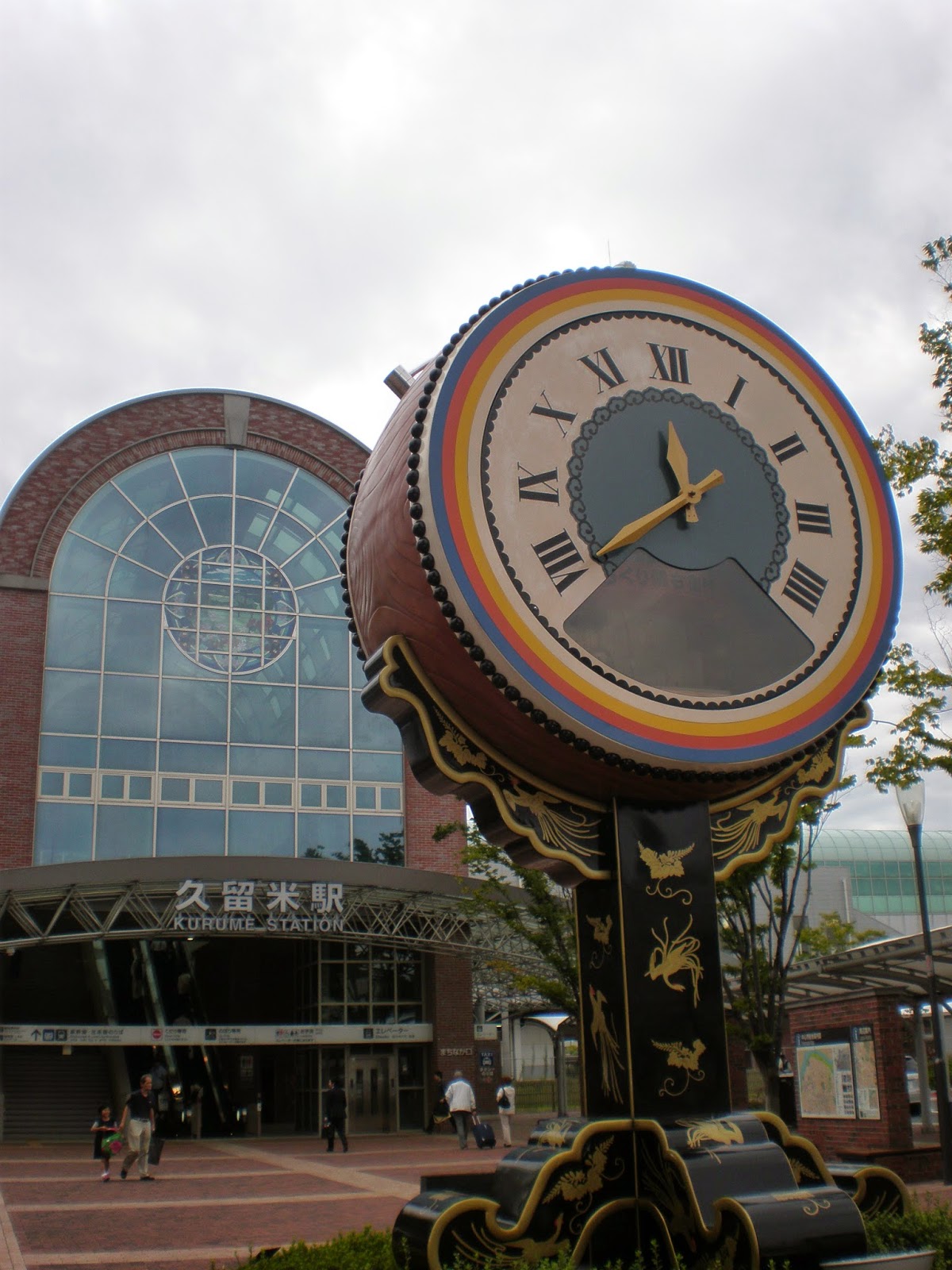
The train to Kusana was an old yellow diesel. I'm still getting used to the juxtaposition of styles in Japan, which contradicts a lot of what's presented. Some things are very sleek and high-tech, and some things (although very few) are old and traditional, but there's a surprisingly strong trend of what I can only describe as military-brutalist architecture and design. That's not meant to be an insult, it just seems the most appropriate term. Stark concrete, square lines and machinery not covered up to save sensibilities. This makes the whole place look quite distinctive to me, despite having most of the same things going on as Britain, on the whole. It's taken me a long while to realise this, but for a Brit, the amount of things made from brick seems very limited: concrete, tiled concrete or corrugated iron seem to be the materials of choice. And of course, there's none of the Georgian or Edwardian styles that most British towns feature in at least some public buildings.

Obligatory snaps for the train-fanciers in our audience.

Kusano was pleasantly quiet, although this effect was somewhat ruined by the fact that you have to walk along the one main road to get anywhere, and this was quite busy. Japan doesn't like pavements much, so walking by busy roads is always a bit offputting for me. However, it's a lovely change from the inner city. Most buildings were only one or two stories, allowing me to actually see views most of the time, and it's an agricultural area with vast sweeps of orchards everywhere. I saw ripening fruits and an array of startling insects. These included butterflies the size of my hand, and I was very sad that none of them would land so I could take their photo.


There were also glittering black-and-gold spiders of about the same size. I include this line as a heads-up to any spider-haters in the audience that a picture of the spider will follow shortly.
If you don't like big spiders, you should probably skip ahead now.
Okay?
Big spider.

Kusano has a slightly esoteric collection of interesting places, and I wasn't entirely sure what most of them are. I was somewhat hampered by the walking map, which turned out to be deceptively scale-free, apparently inspired partly by the London Underground map, and also missing the odd minor road. As a result I ended up taking several wrong turns into dead ends and wasting some time, including walking quite a long way up a hill at one point. Still, it's all good exercise and I got some nice views.


I eventually tracked down the first major landmark, the Kusano History Museum, which let me recalibrate my map and navigate better from then on. Since I knew nothing about the Kusano clan and would be unable to read (or photograph) their collection of ancient manuscripts, I contented myself with looking at the outside.

Similarly, I paid only brief attention to the temples and shrines, on the grounds that I've seen half a dozen of these so far and to the uninitiated they seem much the same. With an interested guide I'm sure I'd appreciate them more, but personally I can't read anything like as much from them as I can from more familiar Western architecture.


My first real stop was at the Yamabenomichi Cultural Museum, a large blue building that felt slightly offputting when I entered. Despite the welcome sign, it felt like I'd just wandered into a primary school or something. There was no actual reception desk, although a woman popped out of an office and waved me in; after that I wasn't at all clear where I was, which parts of the building were actually open, or whether I was going to be walking into restricted areas. It seems like most of the building was display space when I did get round to braving it, and at this point the lady did come in and sort of hang around, making occasional remarks. I think we probably both felt equally embarrassed, since she didn't have much to say beyond pointing me at some pamphlets about the area and awkwardly rearranging things for a while until I moved to another room.


There were some masks and other items that seem to be for use in festivals, a small exhibition of paintings, and another room upstairs with loads of postcard-like things. One of the reasons I'd come here was that YM-san had recommended the cafe, so I duly went inside, but once again found nobody there. It was clearly open, and they had menus lying around, but though I sat and mused for ten minutes or so, nobody ever turned up, so I left. In fact, I would be entirely unable to get a drink nor a snack in Kusano. This was a great shame, because it was a lovely peaceful place, and if I'd been able to stop for the occasional cuppa I'd probably have spent even longer wandering round enjoying the sights.

Just a couple of general glimpses of the town.


This looks like a portacabin, but seems to be a house, possibly made from shipping containers. It's very prefabby, anyway. Given the number of cars, maybe it's some very cheap flats?

This (上野武則邸) was the house of the head of a medical shop, the Ueno family. This kind of elaborate gateway is apparently unusual, especially in this area. It was probably associated with a very formal reception room, to give a grand impression to customers (from the guidebook - I didn't make that up). You can see more pictures at this blog, which I found entirely at random by searching for 上野武則, but turns out to belong to YM-san from the information office! Small world.
My plan was to generally wander around the town and look quietly at things, rather than particularly to view anything specific. I passed a couple of things that were probably quite interesting if one only knew what they were. I discovered that the next major landmark was something that looked like a garden centre and had a flower-related name. Aha! thought the British brain. Surely, if there is anything one can be confident of in this world, it is that a garden centre must necessarily feature a cafe, as well as birthday cards, strange spirally ornaments, soft furnishings, CDs of classic ballads, pets, and possibly even some garden plants.
This turned out to be incorrect, as the building was in fact the Kurume Camellia Garden visitor centre. This seems to be a kind of botanical collection showcasing camellia species. In fact, the building turns out to be only a small part of a much larger whole; the main display is an extensive park up the hillside with about 2,000 specimens of 500 species. I wandered inside and was soon approached by a mildly anxious-looking staff member (a theme in my tour) who was very pleased to realise I could speak enough Japanese to have a conversation. In fact, I should point out that I only understand about a quarter of any given conversation, but thankfully I have spent seven years working in a library full of philosophers and theologians, so I'm entirely used to that.
The Camellia Lady (as I don't know her name) kindly explained a little bit about the place and showed me some of the carmelian products they sold - I actually intended to pick something up, but ended up getting distracted, as we will see. The boss also stepped out to greet me, and I was pleased to discover that (like everyone else I've met) he could immediately associate "Liverpool" with the Beatles. He even gave me a badge made from a carmelian pod. When the conversation dried up, I sloped out to the closer bit of garden, intending to have a poke around even though very little was in flower.


A couple of minutes later, I was hunted down by two of the staff so I could pose for a photo with them and one of the precious few remaining flowers. I have a suspicion that I may end up in some kind of brochure as the token multicultural, which mildly entertains me. A smaller hope remains that I will feature spuriously as some kind of visiting camellia expert, because that would be hilarious. If anyone visits and finds my picture, do let me know!

Sorry about the quality, but it's a photo of a photo.
Since I don't have many photos with myself (it's hard to take them) I thought to ask if I could leave them my email address and get a copy sent. What actually happened was that I came back to the desk after wandering round, and was presented with an A4 full-colour printout of the photo. This was very nice of them, but a bit inconvenient because I'd only brought a tiny manbag and had no way to carry it. I didn't have to mention this, because Staff A immediately started tracking down a folder for it. Then Staff B produced a paper envelope, and inserted the whole in that, and then realised there was a plastic bag and added that to the mix. The bag was a bit small, so Staff A then scurried around the office and located a pack of larger plazzy bags. Meanwhile, the boss was doing something enigmatic at the back, and suddenly produced a photo print of the picture as well. This was duly added to the mix. Somewhat overwhelmed, though very charmed, I left them my email address and extracted myself to go and view the main gardens uphill. Naturally, I did this by first walking back out of the main door, then realising my mistake and doing an about-face back through the hall with an awkward wave.
I didn't have that much time left and had already climbed quite a lot of hill today, but I did make it up to the garden. This part of the day was slightly nerve-wracking, because I was nervous I'd accidentally wander into someone's personal garden or orchard by mistake due to not being able to interpret all the signs. Having eventually tracked down the entrance, I wandered inside. Unfortunately, as it was out of season, it was basically a parkfull of greenery with nary a bloom in sight.


It would undoubtedly be quite a nice place for a peaceful wander at any time of year, but I decided to cut my visit short after ten minutes or so, and hurried on back down the hill and through town, arriving just in time for a train. This would give me time to rest a bit at the station before heading to my hotel for check-in.
There are quite a lot of small shrines dotted about the hillside, as well as graveyards.


My plan was to stop at the station cafe for a much-needed cuppa after nearly five hours of wandering through towns and up hills in warm weather. This was cruelly foiled by the station's dastardly plan of not having a cafe. I can only boggle. As I would later discover, there is one a couple of minutes down the road, but I didn't know that at the time. I sat for a while trying to use the station internet to look up the locations of cafes, since this dearth coupled with not having seen any on my earlier walk left me paranoid. This was duly foiled by the station internet being about as functional as a Public Private Partnership, and I gave up and schlepped my stuff (thanks again, station lockers!) over to the ryokan.
After heading in entirely the wrong direction for a few minutes, thanks to walking out of the wrong station exit, I tracked down the building and was welcomed by a nice landlady. She showed me up to my room, where tea accoutrements were laid out along with a yukata for my use. I had that much-needed drink and rested for a while, slightly puzzled by not having been asked to sign in. After a while I headed downstairs and managed to attract her attention long enough to ask about registering, which is a legal requirement, especially for foreigners. For reasons I don't fully understand she didn't take my passport details, but she did give me the paperwork. There was a lot of confusion over my name, which I wrote out and then she started rewriting in the wrong order in the belief that I had messed up, but eventually this was resolved.
Ryokans are Japanese-style traditional hotels, although they vary in how traditional and formal they are - at my end of the market it's not that different from a B&B run by a nice retired couple from Dorset. I'd seen some ryokan-like places advertised where you basically had a fenced-off area within a common room, a sort of ryokan youth hostel, which really didn't appeal. YM-san described this one using a special term, probably minshuku, and I initially thought she meant that kind of hostel, but I think it has more to do with it being a smaller, homey sort of place with all the facilities shared. Much cheaper to build, presumably. Essentially you are just getting a room with a tatami mat floor, a small table, a TV and a yukata (basically a dressing gown). It's quite nice actually.


The downside is, of course, that without internet my options for entertainment were limited. I couldn't properly write a blog, check or write emails, or do any research on things to do in the evening. I ended up going to Kentucky Fried Chicken (yes, I know, but I had a massive apple later) so I could use their internet to at least do some quick things. In the evening I strolled round town, hoping to find some kind of chain cafe where I could drink coffee and surf the web, or at least sit down; the ryokan only provided a jug of hot water for tea, which would in no way keep me going for four hours. Kurume seens to be almost entirely devoid of such cafes, which meant I wandered around for two hours getting exercise but not achieving much. This would have been more welcome if I hadn't spend most of the past three days walking around towns!
On the definite plus side, it's cool enough just now in this part of Kyushu that I genuinely enjoyed it, rather than collapsing into a melting heap. There was even a brief moment where I was actually chilly. It was great.
As I had no internet, I didn't get round to putting up the Kusano blogpost until the 21st. My original plan was to spend the day in Kurume and area, then take the evening train back to Fukuoka.
For breakfast, I went to that cafe near the station, a place called Trandór. It's very nice actually. There's an array of interesting baked goods, which I sampled a couple of, and they do reasonable tea and coffee. Usefully, I was also in reach of the internet from KFC next door. I sat here for a while checking things and writing emails. Since I'd left the ryokan at 7.45am for want of any better ideas, this seemed like a decent use of time, and I got a couple of drinks down me.
I decided after some thought that I'd pass on the delights of Kurume itself. I'd seen a certain amount of the place last night, and nothing had really jumped out as interesting. The map showed a couple of temples, several parks, and a couple of museums. While in the general way I'd happily go to any of those, most were three miles or so from the station, so I'd have to do quite a bit of walking to get there at all, in order to walk around some more. I could go and research buses at the station, but I wasn't really inspired enough by any of the options to feel like that was worth the effort - and travelling around strange towns on buses is usually pretty stressful.
I'd had some thought of visiting another nearby town, Yufuin, but being short on sleep I lacked enthusiasm, and I believe it's mostly dedicated to onsen (hot spring baths) anyway. The extra time on the train didn't particularly seem like a great investment. In the end, I decided to cut my holiday short a few hours early and just hop on the train back. So ends the First Great Kyushu Mooch of 2014.

And now for the obligatory cake review section. As I hadn't booked breakfast at the ryokan, I ate at the aforementioned coffee shop.
Choc Chip Bun: Nice faintly-crisp outer texture, and a pleasing balance of dough and chocolate. A mild chocolate filling (perhaps a hint of orange?) was neither squidgy nor sickly, and the whole turned out surprisingly unsweet, making it a very suitable choice for breakfast. It had a nice texture, easy to bite into, which didn't stretch or squash too much. Would eat again.
Cinnamon Raisin Bun: Pleasant enough, but lacking punch. A fairly soft cake, with a nice glaze and sugared with a very minor dash of lemon. If this did indeed contain cinnamon, it can only have been in homeopathic quantitites. The raisins were large and plentiful, but the whole was somewhat bland, although perfectly acceptable. I'd cheerfully eat another one, but it wouldn't be my first choice.
