Friday, 19 September 2014

Mooching in Kyushu: Kumamoto day 1

So due to the sabotage of my Okinawa trip, I had to find something to do at short notice. This meant something that I could research relatively quickly, and also something that wouldn't be ruinously expensive to do impromptu. Also, no more planes. That ruled out my wish to visit Hokkaido (too complicated to do on 24 hours notice). Since I'm flying out from Osaka at Chrimbo I expect to spend a few days in the central part of Japan checking out Osaka, Tokyo and maybe Kobe or Kyoto, so I don't particularly want to do that at the moment - plus, it's even hotter than Fukuoka.

In the end I've settled on a fairly simple circuit around northern Kyushu. I took the shinkansen (bullet train) south to a place called Kumamoto, capital of Kumamoto prefecture. This isn't a massive tourist spot, but it has several noteworthy things to see, although I suspect its main salience to the Japanese is Kumanon, its mascot. For various reasons I decided to spend a couple of days here, whereas other places on my planned tour will only get one.

Because I arrived at lunchtime and carrying a heavy bag, I didn't want to immediately start dashing around. A nice lady at the station booked a hotel for me - I've decided this is far simpler than trying to do it online, where painstakingly working out what kind of hotel something is, scrabbling around for pricing information and eventually finding that the rooms are all full takes ages. I was slightly bemused at her insistence on announcing me to various hotels as "a foreign customer looking for a room", something that sounds weird and borderline No Blacks No Irish to English ears, although I assume it has different cultural resonance here.

As my hotel wasn't available for check-in until 4pm, I was delighted to find that the station had lockers! I don't remember the last time I saw one in the UK except at gyms. I wedged my rucksack into one with only minor trepidation, and set out into town. Although there's a tram, I wanted to do some actual walking around a town for a change so I could get a feel for it. Also, that meant not having to work out how the trams work or find correct change. This is a bigger problem than you might think, because foreigners taking out lump sums from the bank to minimise charges tend to end up carrying Y10000 notes - which is all I had on me - while tram fares are things like Y150 and don't provide change. They still use very small denominations here, so the Y1 coin is basically a halfpenny bit, but nothing costs Y1 or anything like it. There's also various taxes added to the nominal prices of goods, so that rather than things being Y100 or Y99 (as the UK would do it) they always end up as Y238 or so on, which means you get a heap of small change. Between eagerness to offload heavy change whenever possible, and reluctance to constantly ask people to change what is essentially £50, I always end up going through my smaller monies and ending up stuck with only large notes.
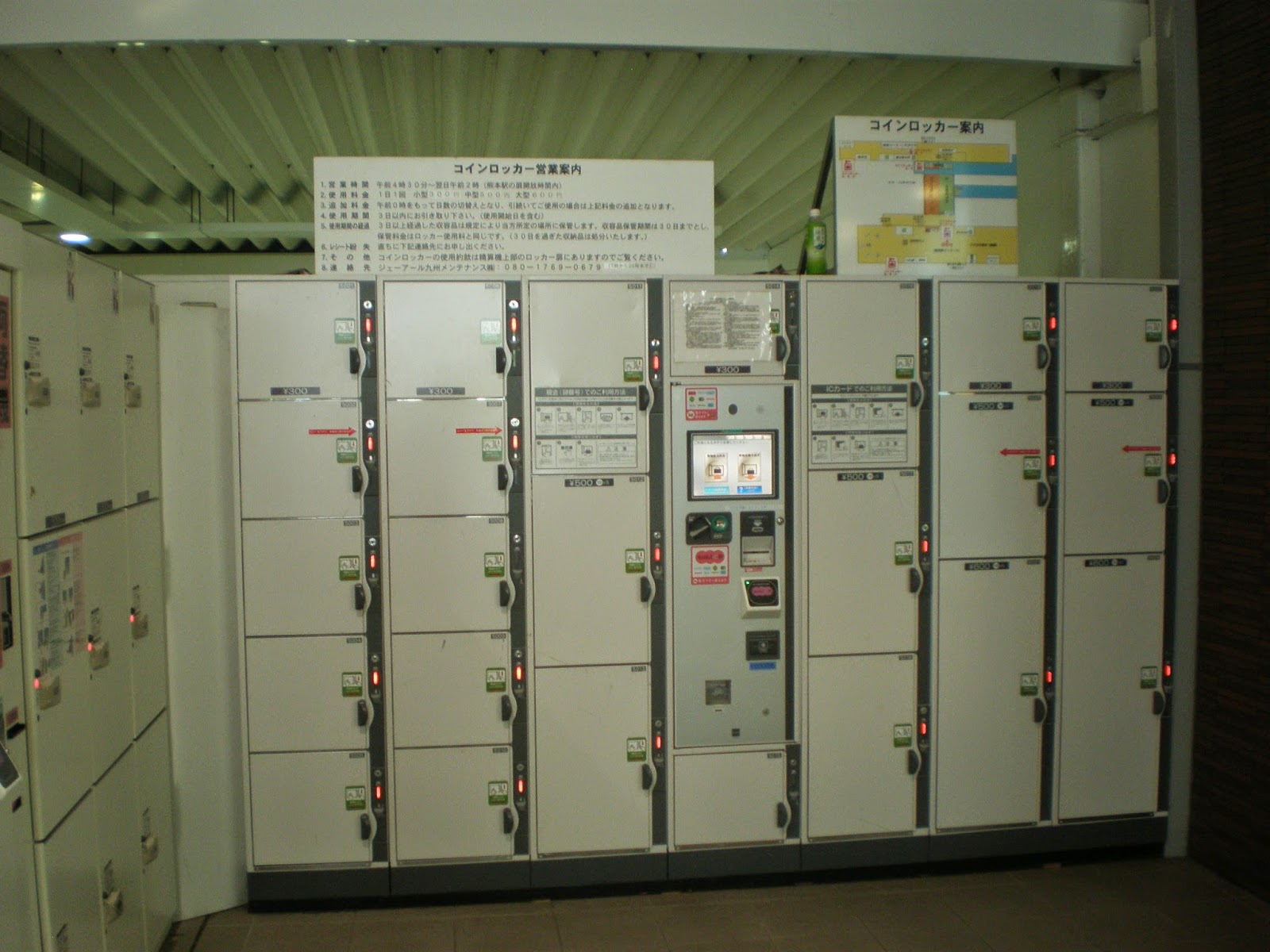
Lockers! Thankfully the screen offers English instructions, because they were a bit fiddly to use.

No idea, but it looks cool. Apparently the one on the right is an obake no Kinta based on a supposed soldier called Kinta. The monkeys are a kind of charm made from clay; there are multiple set designs (presumably with different sets of named monkeys?) are intended to have different effects, like averting disaster or protecting children.

This also puzzles me. Apparently this is a kijiguruma, a wooden pheasant toy. These two exhibits are just randomly embedded in the walls in the station, in an underpass area.

Anyway! It was a moderate and not particularly interesting walk through the downtown of a different city from the downtown I normally walk through, and there was a bit of a breeze so it wasn't that hot. I've undoubtedly been spoiled by upbringing and early jobs, but I still can't get used to the idea of walking for an hour through a city and never passing a piece of greenery larger than my shirt. This isn't something unique to Japan by any means, and not all of Japan is like this, but it's rather soulless. The poor imprisoned rivers cry out for freedom.

This building just caught my eye for some reason.

These multi-story mini car parks are relatively common now. They were, of course, first predicted by Thunderbirds many years ago, in the 1966 episode Move and You're Dead, featuring the Parola Sands car park. That was actually even more complicated than this real-life arrangement:

This seems to be a typical bar-cum-noodle-bar. There are lots of these around, and their main features seem to be: minimal information, distinctly bijou scale, fading exterior in a rather traditional style, and complete opacity to the passing observer. This one is shut right now, but even the open ones baffle me. It's a nice change from British-style massive sheet glass windows, in all fairness.

Most things are going on above your head. If you don't recognise or understand the signs, like I don't, then most of the time you'll have very little idea what's around you.

As I wandered towards the city centre, I stumbled across an entrance to an underground shopping centre called Center Plaza. As often happens, this displays only an English name in the flesh, but is referred to be a different, Japanese name if you try to look it up... this turns out to be センター駐車場側, "center car park", which is less, um... evocative.

It reminded me of St Johns, except that there's an unexpected luxury-looking bit of slightly posh foodstuffs. I can't tell whether the slightly grubby exterior and cheap-and-cheerful food was misleading, or if in fact that kind of Japanese foodstuff shop has a veneer of poshness to me but is not actually posh per se. Ah, cultural differences.

Anyway, I took the chance to eat ramen because it was already lunchtime, and this would spare me needing to look out for further restaurants until I'd been to my hotel. It wasn't quite as nice as the ramen near our school, but cheap and filling. I even ate the egg, which is my first ever boiled egg. Unlike a certain famous compatriot, I am not generally the Eggman.

This isn't quite as black as it looks in the photo, but it was very very dark broth. The vegetables are a kind of thin leek.

Naturally, I ended up taking a different exit and getting a bit lost, but I did eventually get back on track for my first destination.

Besides the weird bear, Kumamoto has a couple of other interesting features. One is a very impressive castle, which I'm saving for tomorrow when I have a full day to look around it, as it's pretty extensive and deserves a proper look. The grounds apparently contain a second very impressive feature, the Hosokawa Mansion, a former samurai residence that's the sort of equivalent to a National Trust country house. Oh, and there's a massive temple next door. So that's going to be a pretty full day.

For my first day, with only the afternoon to spare and hotel-checking to do, I opted to seek out the former residence of Lafcadio Hearn. This very interesting gent was a major contributor to Japanese-Western cultural relations, naturalising here and throwing himself into teaching, writing and translating. I saw his Dublin residence when we were over there a couple of years back. He's of particular interest to me not only for that cultural and linguistic interest, which I share, but because he's the source of Skeealyn Scaanjoon, one of the first works of fiction available in Manx Gaelic, through the efforts of Rob y Teare. Very good it was too. So I thought I'd like to see his house.

What we're after is the lower-right yellow dot just under the pink rectangle. It's labelled "Former Kumamoto Residence of Yakumo Koizumi", his Japanese name. Note the complete lack of labelled geographical features between "you are here" and my destination. It's just a maze of generic shops.

The house was a devil to find. I did my best with the map, but I was coming from a slightly anonymous retail area, and Japan is infuriatingly short on street names, so even when I did know the name of the street I hoped to be on, it was rarely possible to confirm whether that was true. The grid pattern doesn't help here, as many streets are so long that you can't really nip to the end to check for a sign. I was cruelly led astray for a while by a sign that some wag had turned 90 degrees!

Thankfully another one led me back, and I eventually worked out that the little building by the uninspiring bit of open ground was actually the place I was looking for. Cue pause to eat the panettone I'd miraculously acquired in a bakery. It was delicious!

I started by just admiring the outside and its little bit of garden. This was slightly awkwardly curtailed by one of the staff coming out to beckon me inside, clearly under the impression that I was nervous about coming in. They were very pleasant, and one gentleman attached himself to me for a little while to chat about Hearn. This was slightly embarrassing as I already knew most of the stuff, but he was interested to learn I was English, and we had a brief discussion about Irish Gaelic, Manx and whether or not Guiness is a kind of beer (no). After showing me around he left me to wander at my own speed and take some photos - I did ask as old houses don't always like that.

With the doors open, you can see right through to the back garden. I don't know whether someone with this kind of house might have done that at one time, or whether it's purely for visitors' convenience. I do wonder how much grounds the house might originally have had? These sorts of houses always look like they should have expansive gardens.

As I've never been in a Japanese house, let alone a traditional one, it was very interesting just in that regard. There's only so much to say about Lafcadio Hearn and he only lived there for a few years before his death, but there were various displays and most had some English one. These included some student testimonials about his brilliant note-free teaching. On reflection, I wonder whether this was not heavily influenced by his major visual problems (one eye and serious myopia) that would have made working from notes very difficult, encouraging him to get used to remembering things and working orally.

It was a very nice house and I was quite jealous of it. Elegant plainness, all dark wood and paper and soothing tatami reed mats. The spaciousness was also a big source of jealousy for me! So many rooms... I really wanted to move in there and just enjoy having room for once, in this cool and elegant space. On the downside, it was probably both cold and noisy, as they didn't really have insulation and the walls are mostly paper.

Very simply decorated. I can't help noticing that, although it's very nice, I would be suffering from lack of book storage. Ah, property ownership, scourge of the modern age. See also: electricity. This was a kind of living room, although as far as I understand Japanese culture, rooms are usually multipurpose; the minimal furnishing helps with that.

The inner and outer doors seem to be very moveable, so you can allow in as much air and sunlight as you want, move a screen to block an annoying bit of light, and so on.

The actual study, where he did all his work. It seems a horribly small table to me. I need my space to sprawl on (and also I write at about a 45' angle).

Because of the tatami floors, you don't wear shoes of any kind in here. You can also step out onto this sort of veranda affair, so you can be outside but shoeless. It was quite nice wandering around on these mats, I can see why they're popular.

A nice collection of Hearn's works.

On the way back, I spotted a rather nice-looking Catholic church, the biggest church I've seen so far in Japan. I might take a look at it if I'm back in the area tomorrow, but I just wanted to get my stuff and check in. It seems to be Tetori Church and looks rather nice from the photos on their website. There's something slightly odd, though, about going to Japan to (as Stella Gibbons would put it) look at old churches.

After another walk back to the station that set my feet to aching, I picked up my bag, managed to change a Y10000 note and hopped on the tram to my hotel. I'd been lucky in that unlike many places, the hotels in Kumamoto are often right next to the interesting parts of town (downtown and the historic quarter) so everything should be close tomorrow. At this point I realised my head was also hurting and I was worn out, so I let myself collapse for a bit. I woke to a pounding headache and lack of appetite, but it was obviously sensible to get some food.

Hotel room is about as spacious as my apartment, and rather better-equipped.

A long walk to the local supermarket ended with the discovery that it had unaccountably closed down, so I scrabbled together a couple of edibles at a convenience shop. The range of things you can get in these is very different from the UK and a bit troublesome if (like me) you want something simple and undemanding when you're ill. They sell a lot of sweets and snacks, plus various ready-made lunchboxes with rice and vegetables and things. No bread, no fruit. Fine, but not ideal when you're in a microwave-free hotel room and really just want something very plain and simple. I will pass over the bread (to everyone's undoubted relief) and simply report that I did manage to assemble and eat something resembling a sandwich.

Retiring to my room, I wondered whether the headache might have something to do with only getting one cup of tea all day. I'd had water on the way here, soupy ramen for lunch with only more water to drink, accidentally bought mugicha (a sort of rough barleycup equivalent) on my walk back, and got one cuppa at the station cafe before setting out again. So I cracked open one of the surprisingly limited selection of drinks (two) in my room. It had plum blossoms on it and was called (roughly) Plum Tea, so presumably it was green tea with plum added, like how jasmine tea works.

A beautiful, promising greenish-pink colour promises fruity goodness.

Nope. Very much not. Yech!

On investigation, 梅こんぶ茶 (umekonbucha) is a beverage made from pickled sour plums and seaweed. It's a bit like miso soup, and nothing like tea. It also isn't what I want to drink right now, especially since it doesn't contain even a scrap of caffeine! Another time, knowing what I was getting into, it might be acceptable.

After some scrabbling, I found an instant coffee machine hiding in a corner of the lobby. I'm deeply confused about why there isn't a pile of tea sachets in the room, given the Japanese attachment to tea. I'm beginning to think that, although tea is culturally and traditionally important here, tea as a fresh hot beverage just isn't as popular as in Britain. There's loads of chilled bottled tea in vending machines, and people drink lots of coffee. I wonder whether, by the time it reached the cheap-and-plentiful stage that would make it universal as in Britain, they already had alternatives? Or maybe it used to be popular but has lost that position now that alternatives are available. Also, of course, it's hot here. Caffs will always ask whether you want your tea chilled or hot, a question I have never encountered in Britain.

These photos have nowhere to go

Sometimes I just want to take a photo.

These chairs were deep in the bowels of the bus station, shrouded in gloom and with no company but the nearby rumblings of buses. Not a human was in sight. I found something deeply lonely and melancholy about them, which is in no way captured by this hacklike photo.

Is this not an intriguing door? It proclaims "Adventure!". Most likely it belongs to an accounting firm, the delivery entrance of a printer paper manufacturer's office, or a 36-year-old assistant sales executive called Takeshi who works six-day weeks and enjoys drinking beer while watching television and eating instant noodles.

What lies up this dark, intriguing-yet-discouraging staircase? Surely, surely, it is the office of some secret society or a branch of MI6?

It claims to be a purveyor of Korean snacks. So would I, mate, so would I.

This building has a row of wooden placards outside it and lanterns, very reminiscent of the temples I've visited. Initially I wondered if it was a small, discreet and rather unusual shrine, or some Shinto-related premises at least. I'm not sure if this is a deliberate reference or just coincidence, since on closer inspection it's apparently a bar listing the names and prices of the drinks available.

Tuesday, 16 September 2014

Not in Okinawa

At this time, I should be settling into my hotel bed in Okinawa, excited about the Foundation for Endangered Languages conference tomorrow, where I should be attending my very first conference, meeting all kinds of fellow minority-language nerds, and seeing some of a very different part of Japan.

None of that is happening, though, because Peach Aviation turned out to be a worthless bunch of chancers. Our flight was first delayed for an hour and a half; half an hour after that deadline, they suddenly announced that the flight was cancelled entirely. No, there are no more flights anywhere tonight. No, it's not possible to put anyone on any alternate flight until possibly Thursday at the earliest. Given that almost everyone had very specific dates arranged, this naturally did not go down very well.

There's no point me going to the conference on Thursday, since I'd only be around for one day of conference and would probably not get to know anyone. Several hundred pounds for one day of a conference is not a price I can justify, so I've cancelled entirely in the hope of clawing back some hotel fees - which, inevitably, Peach refuse to compensate for. They won't pay for anything whatsoever except the actual cost of the tickets. Apparently this is legal. The mind boggles. All I can say is, don't fly with Peach. Take whatever measures seem necessary to avoid flying with Peach. Don't let your friends fly with Peach. If you suspect that a family member, or someone you care about, is considering flying with Peach, be sure to tell a responsible adult. I can only be glad I'm not the couple next to me, who were astonishingly calm at having their honeymoon disrupted and the alarming prospect of four further Peach flights on their tour; or the two other couples I saw in tears at the news.

It's also now too late to book with any alternative carriers. The only vaguely affordable one has a bafflingly-complex website entirely in Japanese and I daren't risk doing anything. I've started looking into other things to do with the time, but again I'm just not sure I can at this stage - particular since everything is in Japanese, and so much much slower to deal with. Plus, I expended a lot of emotional energy planning for and getting ready for this trip, which has come crashing down, and I'm just not sure I have it in me to do something spontaneous now. Certainly not at this time of night.

I'm in a horrible mood, really disappointed about my plans falling through and worn out after spending hours sat pointlessly in an airport followed by emailing people to try and cancel bookings. On top of my recent cockroach encounters, and enduring frustration with the weather, I just really don't want to be here right now.

Monday, 15 September 2014

Culture Class: gift-wrapping lesson

This is another of the Traditional Culture offerings at GenkiJACS. They're ending up spaced out because it takes me a while to write a satisfactory post, but this one was actually the day after the cooking class.

Wrapping class

Our class was run by 高倉 Takakura-sensei of Mame's Ribbon. She covered two types: furoshiki wrapping and modifying paper bags. Sadly, I have only one in-class photo of this. We moved pretty fast and both hands were busy wrapping most of the time, so there wasn't much chance to take photos.

The bags were fairly ordinary stand-up paper bags. We modified these with a mixture of origami-like folds and small cuts, eventually transforming the bag into an imitation button shirt, which we decorated with a ribbon for a tie. It's not something I particularly see myself doing (office wear doesn't strike me as something to inspire delight), but it was an interesting exercise.

Furoshiki (literally "bath cloth") are a kind of traditional cloth that was originally used to wrap up clothes while you were in a public bath. There was some suggestion they actually started out as a kind of changing mat, but I'm not sure if I got that right or if there's much evidence. Anyway, they are traditionally used to wrap things in Japan, including some kinds of purchases, presents, and also lunchboxes. They're flexible and can be turned into all kinds of things, made into ornate decorations, or used to create a handle to carry something.

We went through the basic two knot types, which were more or less a granny knot and a kind of reef knot. We then used these to create a variety of things, including a simple bag, a parcel, a way to carry two books of similar sizes, and a kimono wrap for a wine bottle!

As before, Kayoko-san escorted us and handled translation as necessary. We had a short introduction to the history of Japanese gift-wrapping before we started, and more details filtered in as we went along. There isn't a huge amount to say there (although undoubtedly there's more to it than can be sensibly covered in a short practical introduction) but I quite enjoyed it.

This class was pretty interesting, and the teacher was nice. It felt difficult to fit everything into the lesson, though, which was a shame - with travelling to the studio and back, and the faffing time while people find seats and root around for objects, the two hours or so assigned to the classes sometimes don't feel very long. Sounds like a complaint, but you'd probably rather have people wishing for more than getting bored, and I reckon my tolerance will be higher than some people's. This is especially true as I sign up for each class, whereas people registered on the culture courses just attend all their assigned culture lessons, and may find the odd one isn't to their taste.

There was also a slight practical issue, in that we had really one or two more people than comfortably fitted - wrapping things properly takes a fair bit of space, and there were definite issues in that regard, although everyone was accommodating as far as possible. There's only so many people who can fully unfold a piece of cloth on the same dining table at the same time. Similarly, coming up with enough objects to wrap was a slight problem, and a couple of people ended up with things that couldn't quite be wrapped as intended, so I do have to mark the experience down there for future reference. I was lucky enough to end up with things that worked.

As with the cooking, I'd have liked a bit more time - in this case, to go through this in a more relaxed way, and maybe try some of the exercises more than once to help them stick. Honestly, I don't think I'd remember any of them unless I found some instructions. I'd put it as a lower priority than the cooking class, but still something worth doing if you have the time. If you're a craftsy person, particularly the sort of person who likes getting into handmade cards and ornate gift-wrapping, it'll obviously be correspondingly higher up the list.

Although there was nothing to eat this time, we did all get a furoshiki as part of the class, which I'll probably use in wrapping Christmas presents this year. I'm tempted to look out for more, but so far I haven't actually found a shop that stocks them, despite being assured they're cheap and easy to find. I suspect that, as so often with touristy things, Fukuoka residents probably don't often want to go furoshiki shopping so aren't entirely on top of the market.

A plea for sanity

Dear Japan:

I wanted very much to enjoy our time together. You seemed pretty cool and interesting. I was really hoping this would work out.

But you have to do something about these cockroaches.

When I get woken up at 00:40 to a baleful scrabbling sound, and that resist that growing dread in the pit of my stomach for as long as possible before finally getting up and turning on the light and seeing the inevitable boding shape lurking in my kitchen, and spend ten increasingly-stressful minutes chasing the nine-times-damned manifestation of all that is vile around my kitchen wearing only pyjamas, painfully aware of the bareness of my feet and the creature's delight in climbing up things - when I am left clinging onto surfaces as I reach anxiously into cupboards with only a thin plazzy bag on my fingers to try and catch the bugger - when I finally chase it outside and am left coated in a fresh layer of sweat, anxiously miserablely aware that another might manifest at absolutely any moment, and entirely unable to sleep - then I feel justified in saying, Japan, seriously, cockroaches.

Saturday, 13 September 2014

Cake report 2

So, following on from a previous adventure, I have picked up a pile of cake from Bel et Bien and will now eat them for your reading pleasure - although, admittedly, mostly for my eating pleasure.

Milk Tea Scone

This has a definite scent and taste, of tea. Assam, I would guess? The little flecks appear to be actual tea leaves used in the baking. It's a bit peculiar, but not at all unpleasant. On the other hand, the sense of oddness is pronounced enough that I think it would take a few goes to stop focusing on how unfamiliar it is and just appreciate it as a cake, which is a bit of a downside. Definitely worth trying if you like both scones and tea, though. I sense that this will require further study to acquire the taste, and am prepared to valiantly do my bit.

Chocolate chip muffin

Exactly what it says on the tin. This is a very traditional bit of vanilla sponge cake with chocolate chips. No unexpected fillings to drip on your shirt as so many muffins lamentably do; it's fairly light and not particularly rich, so didn't make me feel stuffed after eating it. It's honestly more like a general chocolate chip bun than what's usually sold as a "muffin" in the UK. Very acceptable, would eat again.

Green thing

Yeah, I don't remember what this was called.

It has a soft spongy texture; neither rubbery not squidgy, and very slightly sweet. There's a faint flavour and aftertaste that might be maccha, a kind of strong powdered green tea - a lot of things are maccha flavoured here. It's entirely inoffensive, but equally isn't especially interesting. If you like pretty plain cakes, this is probably a decent bet. If you prefer something studded with chocolate, sprinkled with sugar and filled with cream, less so. I'd recommend eating it alongside something with a bit of flavour of its own, like a milky tea - coffee seems a poor choice because the strong taste would completely mask the flavour of the cake.

Bean bun

This is somewhere between a hot cross bun and a date-and-walnut loaf in terms of texture. It's studded with what appear to be adzuki beans (the ones used in the ever-popular red bean paste) which do in fact taste a bit like dates. Another mild cake, it's a little odd for my taste - having all the beans embedded in the crust means it's unbalanced. Biting into the cake gets you a mouthful with an awful lot of bean, which has a slightly sweet claylike texture, while the cakey middle part is very bland. I suspect I'd have preferred it more evenly distributed so the beans would be a counterbalance to the sponge. Not a big fan, but equally I wouldn't turn down a homemade version or a gift, it's not revolting or anything.

Half-term update

I just finished my first term at GenkiJACS and wanted to reflect on how I feel about things so far.

The school

The school is good, definitely. I've made clear progress in my Japanese, not just in terms of vocabulary or memorising facts, but more broadly. I'm more confident about using Japanese, to the point where I will cheerfully (if confusedly) talk to shop assistants in Japanese, rather than giving up and using English or avoiding conversation. I'm getting a better sense of things like having a conversation - how to throw in a word or two to show approval or interest, how to pull the meat out of a sentence without understanding the whole thing, and coping with a variety of different accents. It's impossible, of course, to separate out what I learned at school from the more general experience of living in Japan.

The staff are universally friendly, helpful and interesting. We have some great discussions in class, as well as covering the actual lesson material. Naturally, some people's style works better for me than others, but I feel like I get on well with all of them. There's good feedback on assignments, and while I try not to delve too far into full-blown linguistics, teachers always try to answer the technical queries that I do raise. The teachers and admin staff alike are always happy to give suggestions or advice for general "living in Japan" issues. I've found dealing with any bureaucratic stuff straightforward, as the staff will always work through things with you, even when it's not really school-related. They have helped out with things like booking my trip to Korea so I can renew my visa, which makes that much less stressful.

Class is fine, though naturally interest varies with the particular material, exercises, classmates and how much sleep I've had. As a long-term student I've gone through a mix of classmates, so I've always got new things to pick up and more to learn about all these interesting people. Some have been great company for lunches or shopping trips, some are full of interesting information; none have yet been annoying. By a process of elimination, I may well be the annoying one.

The facilities are fine, although they're clearly stretched to their limit now during the peak season. We have unlimited hot drinks, and for my undescriminating palate they're good enough - some of the coffee purists I've worked with would be dismayed by our family-size tub of instant. I can usually find somewhere to eat lunch, even if it's occasionally squatting on the floor of the lounge. There's a popular games console, where I've occasionally whiled away a bit of time with classmates but am hopeless at the fighting games on offer. Having to switch shoes to head to the loo is a mild irritation but part of Japanese culture.

I think the only niggles I really have are size and storage. Obviously the school wants to take on as many students as it reasonably can, but it does sometimes end up near-impossible to sit down in the lounge, or to fight through the crowded reception bottleneck between the entrace, classrooms and lounge. I've made very little use of the lounge for private study, because I've just found it awkward to get space during the summer.

Storagewise, I'm sure it's a logistical issue, but lockers are about the only thing I genuinely find missing from the school. It's very hot here, and toting around a hefty textbook, notebooks, reading material for lunchtime and my lunch gets old fast. If I want to do any study in the lounge or a café, I also want to bring my laptop, which is pretty heavy. And I need to shop for food just about daily, and some of that stuff is very heavy (milk, juice, fruit and veg). The end result is that I can easily end up with a ridiculously heavy rucksack by the time I'm heading home, sweating buckets. It also makes it unappealing to do things like go for a walk before or after school. Lockers would be a massive help. I could stow my textbooks at the school instead of carrying them back and forth, especially as most of us try to finish homework in the lounge, and actually if I did this I wouldn't need the rucksack at all. I could bring my laptop in without concern that I'd have to lug it around all day if I went for a walk with someone, as I could leave my stuff in the lockers and collect it before school closed.

Fukuoka

Fukuoka is about as interesting as I expected it to be. It's got some stuff to look at, but like most cities it has limited entertainment value unless you have friends to hang out with. It's a pretty comfortable place, and barring my constant cyclist paranoia I've never felt any concern as I wander around at random, even in the dark. There's a lot of things I'm clearly not taking advantage of, like its array of restaurants, because going into restaurants on my own is just not a thing I do.

It is a very 70s-looking city, consisting mostly of large concrete buildings. There are a few small parks, but minimal greenery of any kind, and every route anywhere is clogged with roads. Most of the pavemants are very narrow and shared with daredevil cyclists. This, plus the heat, means I haven't found it particularly interesting to walk round at random, although I walk anyway out of habit and need for exercise. You can't stroll down the river, because all the rivers have been turned into large concrete drains with zero ecological value. Birds are few and far between. It's a perfectly liveable place, but not one full of romance and leisurely places to stroll.

Shopping for basics is pretty easy, once you work out what you can get and how to identify shops. It's definitely pricey, but not ruinous for someone coming from the UK. That being said, I only really buy groceries and the odd book, so I've no idea of the general shopping scene.

As regular readers may have gathered, the weather is not a friend to me.

Apartment

The apartment is cheap, liveable, but deeply inconvenient in many ways. There's nothing like adequate storage, so it's always a bit of a mess, and I'm obliged to keep bin bags inside awaiting the twice-weekly collection, which is just a bit minging. The kitchen is completely inadequate spacewise, so things like dishes and cooking are a massive pain. Sometimes literally! The crowdedness of the 1'-square area immediately next to the hob leads to regular mid-cooking complications and I've ended up with several burns as I struggle to prevent disaster (say, plastic items tumbling into the flame).

I've also had to deal with more cockroaches than I appreciate in my living quarters. Slugs were bad enough.

The air-conditioning is old, and has no instruction manual, so I can only use very basic features even though it appears to be a bit clever. On the plus side, it does have air-conditioning.

Sticking with positives, it's a quiet set of flats with no problem neighbours and very conveniently located. The underground, corner shops and an inordinate number of dental clinics are all within a stone's throw.

Current feelings

I'm just about to head off on half-term for three weeks, during which I need to attend a really cool conference in Okinawa (excitement!), go to Korea so I can get a re-entry visa to last me until Christmas, and prepare for my exam. I'm definitely a bit tired out and will appreciate the break, although I suspect I'm also going to get pretty lonely.

And my poll question: Would I do this again, knowing what I do now?

Hmm. Umm. Sorry, but not.

I should say that this doesn't reflect at all on the school, but is entirely a climate issue. I knew in advance that it would be hot and muggy, and this isn't my kind of weather, but I hadn't appreciated just how much of an impact that would have over three months. I spend an awful lot of time tired and cross as a result, and just about everything is less fun in the heat. I'm used to walking everywhere and walking a lot, but here it's a very unappealing prospect, and I've ended up exploring the city far less than I normally would - no three-hour walking tours for me. Running, my go-to sport, is only feasible for me late at night in pitch darkness when the temperature drops to 25C or so. I find it near-impossible to sleep without air-conditioning, which is expensive and environmentally-disastrous.

The annoyance of going out also means I end up spending a lot more time indoors than normal. Whereas of an afternoon I'd generally look to head to the park with a book or laptop, I'm reluctant to do that unless I expect to spend a fair bit of time there, because of the effort involved. On sunny days it's often too hot to sit out in most places, while Fukuoka is also prone to sudden rainstorms that would ruin a day out (and indeed a laptop), so I don't want to do it on cloudy days.

While I might consider coming to Japan again, I just don't think I'm a person built to cope with temperatures much above the 20C mark on any kind of regular basis. A return visit to Fukuoka doesn't seem like a great option for me.

Sun, sea and sand at Momochi beach

So last weekend I finally fulfilled one of my ambitions and made it out to the sea. I've planned to do this a couple of times previously, but it always fell through one way or another. On one occasion I sort of lost my way and ran out of time to see both the library and the seaside before I collapsed from hunger. Other times I didn't wake up early enough. Sounds silly, but it's a real issue because of the weather here: if it's 30C and the sun is beating down by the time I leave the house, a 40-minute walk each way plus walking along the shore is a deeply offputting prospect.

This time I was up and out by about 7.30 and able to reach the shore area by soon after 8. I stopped in an interesting little circle to eat some cocoa-laced bread and have a drink.

I assume that is where they release the bears.

I too am not sure what this place is for. I'm sure any resemblance to a massive occult ritual circle complete with viewing gallery is entirely coincidental.

I have no idea. It appears to be gigantic, angry pigeon in some kind of neon plastic Transformers outfit, preparing to give its world domination speech to an assembled crowd of minions. Or possibly an enormous clown representing Fathers 4 Justice?

The actual shore area gets a bit confusing. As you approach, all kinds of odd buildings rear up in strange road configurations, so you have to weave and dodge around them to get closer, slowing you down a lot. The chief offender from my line of approach is the local baseball stadium and attached museum. This is the area of Momochi, for which the beach is named. It's a reclaimed bit of seabed now filled with commercial stuff.

I did eventually find my way to the beach, though.

Ah, the Fukuoka seaside! All the glamour and romance of Rhyl, here at your fingertips.

This bit is rather nicer. As well as not being directly on a road, it features the first bit of actual grass and trees you can walk in that I've seen since arriving. I sat here for a while reading and cooling down after my stroll along the beach.

This bit begins to rival Crosby front, although it's sadly lacking in soothing wind turbines.

This noble shop at the west end of the beach sells ice cream, and is thus the most important facility for some distance around. There were some other shops too, but I've no idea what they were.

This seems to be a hotel nestled amongst the shops. I couldn't get that close because uniformed security people were standing around, so I'm not entirely clear what it is.

I believe this is Fukuoka Tower, Japan's answer to Blackpool Tower.

I had a nice relaxing couple of hours loitering around the beach before I headed for home and lunch. And promptly got lost again!

It's a pleasant enough little place, with a tiny bit of a breeze. I was really hoping for the kind of bracing fresh sea-breezes offered by my home shores, but I think I'm going to have to accept that Fukuoka just doesn't have fresh air. I wouldn't make a special trip to see it, but for GenkiJACS students it's likely to be an easy trip, either because you're living in the apartments around Befu and Ropponmatsu, or by taking the Hakozaki or Kuko lines from the school. If you like heat and blazing sun then a summer visit will probably suit you; I'll be restricting myself to early-morning trips until the weather changes. There's a reasonable amount of beach given it's a city, so you can have a bit of a walk along it, quite probably the longest road-free walk available in Fukuoka.

Friday, 12 September 2014

Our friendly staff can help with all your problems

Never let it be said that the staff of GenkiJACS are remiss in their duty. Their exertions for the sake of us students know no bounds. For example, just the other day, one of my teachers (who shall remain safely nameless) thoughtfully brought in the following just for me:

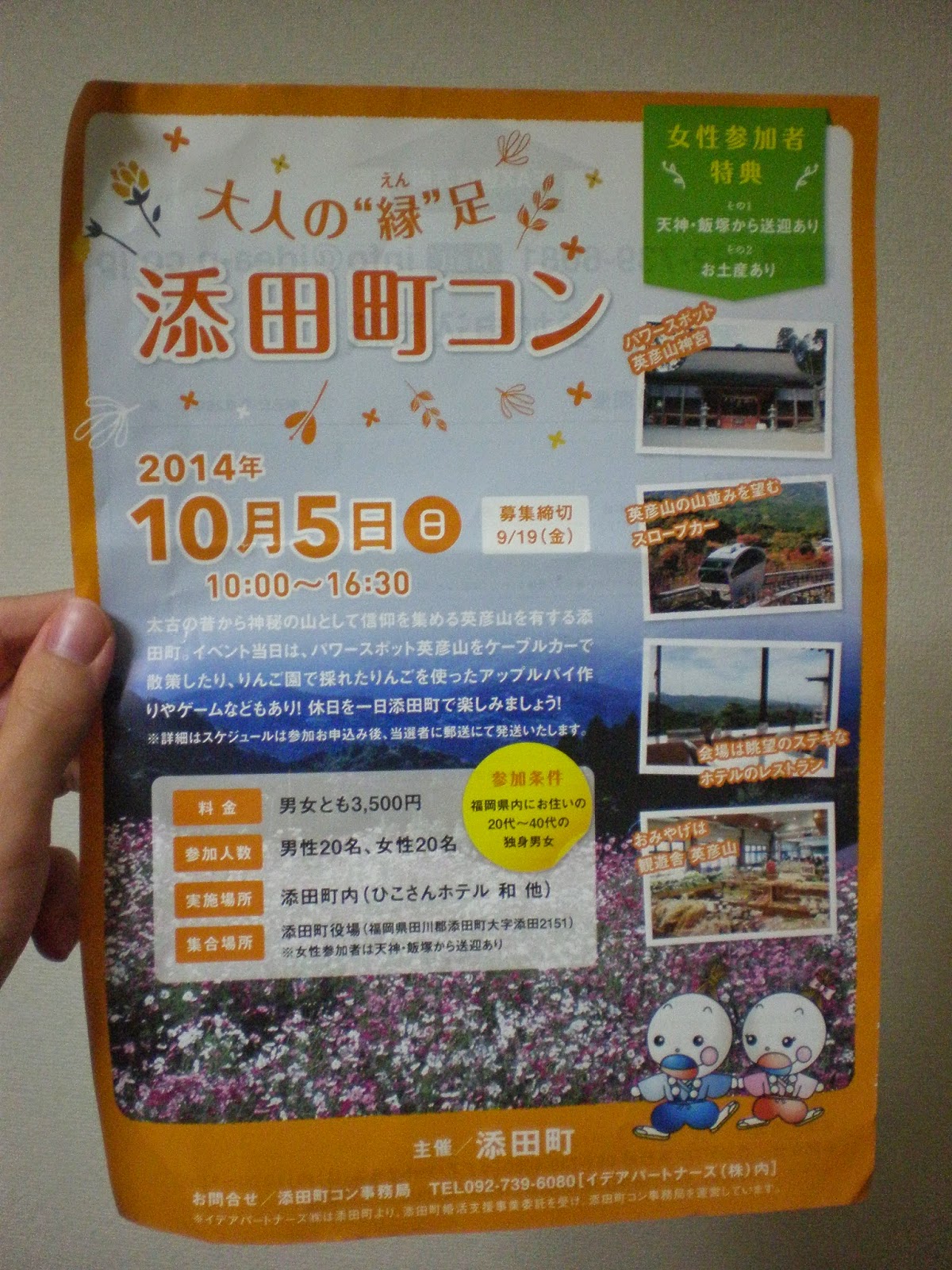
It was being handed out somewhere in town, and seemed practically made for me, apparently.

女性参加者特典
その1 天神飯塚から送迎あり
その2お土産あり

大人の“縁”足

添田町コン

太古の昔から神秘の山として信仰を集める英彦山を有する添田町。イべント当日は、パワースポット英彦山をケーブルカーで散策したり、りんご園で採れたりんごを使ったアップルパイ作りやゲームなどもあり!休日を一日添田町で楽しみましょう!

So here's a very broad overview...

The header is a pun. It sounds like "grown-ups' day out", but one of the characters in "day out" is replaced with a homophone "縁", which relates to family ties, relationships, or shared destinies. So it means something more like "grown-ups' relationship trip".

添田町 (Soeda) is a town a little way from Fukuoka, with a rapidly declining population (halved since the 1960s). With the loss of the coal industry, it's now an agricultural town, and a fairly isolated one at that. Seems, ah... peaceful? unspoilt? Other words that aren't "backwater"? In fairness, I should point out that the town I come from is about the same population, has a far less attractive setting, and almost certainly far less to do of an evening. Glass houses, and all that.*

The flyer is an invitation to a dating event aimed at helping bolster that population by luring in residents from across Kyuushuu. Not just any dating event, mind you - this is an official event put on by the local council. I am suitably appreciative and amused. This ties in to some mild teasing that was going on in some of our classes, so I can sort of see sensei's train of thought!

I have seen a vaguely similar idea in the UK, aimed at helping single farmers find love, but as far as I remember that wasn't sponsored by the government. Clearly Japan is more advanced in this field.

The flyer promises a delightful day in the mountain town: a trip to a hill that's said to flow with mystical power, visits to the orchards, making apple pie, and various games. Sounds like fun!

The lower text I wrote out comes from the prominent top-right green box, and is duly significant: it offers transport and a free gift to female participants, which I suspect reveals the main point of this event. Like the British farmers, Soeda is probably particularly short of wives. From everything I've heard, the life of a farmer's wife isn't that much fun, and perhaps the local girls preferred to move away to the cities if they expected nicer lifestyles there. It does allow men to join in as well, but they're clearly less of a concern.

Since someone is bound to ask: no, I won't be taking up this offer (I don't think I'd even count as a local resident, so I probably couldn't if I wanted to) but I appreciate the spirit in which it was meant. My teachers are great!

* In case of confusion, I should point out that this is a reference to a metaphor. My hometown does not in fact feature any glass houses, which would alone vastly increase the entertainment possibilities offered by the Armpit of Nowhere.

Monday, 8 September 2014

Culture Class: cooking lessons

One of the things that appealed about GenkiJACS when I was looking for a school was the wide array of non-classroom stuff that's available. As well as a range of socials, excursions and other extracurricular opportunities, there are two kinds of cultural classes available: traditional culture and pop culture.

While my main interest is actually in the language (yes, I know, I'm weird) I am also interested in culture in general. There's a pretty wide selection of different activities in each of the categories, so I think they repeat about every five or six weeks? This means anyone coming for a shortish time probably won't get to try everything, and that over a medium-length stay there's a good variety of activities to try. Mostly these are built into specific Traditional Culture and Pop Culture courses, but anyone can join in (space allowing) by paying a fee for the additional class.

It's slightly cheaper to opt in for a whole week, but because I'm staying for a long time, I want to eke out the activities over my stay so I don't run out of things to do. I won't want to try everything. Taking just the odd class also means my schedule stays more or less level, rather than having some weeks far busier than others. All that being said, I did in fact take three classes in one week at the end of my first month, because they were all interesting and I felt like it.

Looking over the range of courses (which are shown on a huge whiteboard schedule) I'm interested in about 90% of the traditional culture, but only a small proportion of the pop culture (like the manga art class). They're tailored to particular audiences, and I happen to not be especially into a lot of the pop culture things, but they seem pretty popular with people who actually know about Japanese pop culture. At the risk of sounding like a snob, I'm not especially into pop culture in general - mostly because I have my own very specific corners of nerddom to retire into. On the other hand, I believe one of the visits is to a cat cafe.

The first week's classes were Cooking, Furoshiki Wrapping and Traditional Painting, all of which were intriguing. Okay, I have no history of wrapping stuff, but if you've read any of this blog so far and not twigged that I like food, you may be a little slow on the uptake. All the culture classes are run under the auspices of Kayoko-san, who leads the students to various workshops or sites of interest, explains everything, and translates for the instructors whenever it's necessary. She's fun.

Today, cooking.

横山 Yokoyama-sensei's cooking class

As it turned out, we had two fun activities: making makizushi (stereotypical rolled sushi) and making udon noodles. Both from scratch.

The udon was relatively simple: mix flour and water into dough, knead it thoroughly, leave to sit, roll thin and slice into noodles. Not easy, just simple. One classmate was amazingly good at this, and most people were fairly shy, so he ended up doing a lot of it. I'd actually have liked to get more involved but felt guilty pushing in; navigating this kind of thing is tricky, especially when people are from multiple countries with different cultures and languages. Getting the dough to the right thickness, and slicing the noodles finely, required a fair bit of concentration.

While the dough was sitting, we made sushi. First, we had to make some omelette to form the middle of our sushi. These used a square omelette pan that I've seen frequently in Japan - it seems much better than a round pan (easy to get a broad spatula underneath!) so I'll probably try to bring one home. The final sushi involved omelette, chicken scraps, cucumber, and some long thin salad vegetable I didn't recognise. A mat of dried nori (seaweed, the same used in laver bread) was laid out and spread with a thin layer of sushi rice - this was the hardest part of the whole business, because a substance consisting of large, irregular sticky grains is not easy to spread evenly!

The rest of it was simple: carefully arrange a small quantity of the ingredients in the centre, carefully fold up the lower edge (left free of rice) and roll it over the filling, and the seaweed binds neatly with a firm press. Then you lovingly slide it into even strips - I used my thumb as a handy measure, while someone else used simple repeated halving to make beautifully even sushi.

Meanwhile, the udon was cooked briefly in a broth made with some vegetable, probably kombu kelp? With all that finished, we sat down with some green tea and ate. It was delicious. I had to leave one sushi slice, due to sheer lack of stomach capacity, and was deeply grieved. You're getting a lesson and a meal; what's not to like?

Yokoyama-sensei was easy-going, fun company, and clearly knew exactly what she was doing, not just in the cooking (she's a professional, it's to be expected) but in guiding a group of ignorant beginners with poor Japanese through the process, ably assisted by Kayoko-san. I had a really good time here, and would gladly go back to try my hand at something else. As far as I know that isn't an option, but in a month or two I might well be up for having another go at the same thing.

Monday, 1 September 2014

Dazaifu and Umegaemochi

Recently I noticed that one of GenkiJACS' many events would include a half-day trip to Dazaifu. I'd heard quite a bit about the place, and was always intending to visit, but hadn't made particular plans. The trip offered some company, a bit of guiding around the place, and most importantly, a chance to try making 梅ヶ枝餅 (umegaemochi)! These are a kind of rice-dough cake filled with sweet bean paste, a local speciality said to help ward off illness. You had me at "cake".

It was only a few quid for the trip, and considering this would include travel costs and the umegaemochi lesson, it was a steal.

As usual, there wasn't a huge amount of detail available on the signup sheet, so these outings all have an exciting edge of the mystery tour about them. We congregated at 8.30am on Sunday last weekend at the school. Here I learned the first new thing, which was that this trip was not a GenkiJACS-student thing, but arranged by one of the school's apparently innumerable cultural partners. To my shame, I can't actually remember what organisation it was. Rather than ten foreigners meandering around Dazaifu, we would be ten foreigners and six Japanese members of the partner organisation, making it a combined cultural trip and conversation exchange. It was a little intimidating at first, as it always takes a little while to tune my ear in to a new conversation partner, but after some rather nervous group introductions we seemed to get on okay.

In practice, some of the GenjiJACS students didn't turn up (I assume oversleeping was the culprit) so we were evenly matched. The trip proved a pretty good mixing-ground because there were several points where we ended up naturally changing conversation partners: one leg to the station (my first trip on an actual train in Japan), two short train journeys, and wandering around town for a short while before we went for our cooking lesson. I got to talk to several different very interesting people, all of whom spoke admirable English. One nice thing was that most of them are currently working, whereas a lot of events are arranged by local undergraduates; this put them in a similar position to me and made me feel less old, frankly.

One for Andrew

The organiser of the expedition, whose name I unfortunately don't know, kept everyone together and had bought tickets in advance for the GenkiJACS group, so we didn't have to brave the ticket office.

Sadly, the weather was a bit grim, which meant the town itself was not especially preposessing. We were also a bit tied down by our schedule, so we spend about fifteen minutes splitting into pairs or threes for a quick wander around the immediate vicinity of the town hall, where our lesson would be. A very high proportion of the shops here are food shops. I visited a specialist rice cracker shop, where I bought one fine rice cracker and tried a couple of free samples.

A little further down, my guides were shocked that I hadn't tried the local speciality 辛子明太子 (mentaiko). I couldn't remember exactly which foodstuff it was, and was persuaded into a shop which had bowls of red stuff and a heap of rice. Ah, yes. Mentaiko is basically a sort of caviar, and around Fukuoka it's generally spicy, apparently. I had a little scoop on a little pile of rice - it tasted like some vaguely fishy spicy stuff on rice. It was fine, but not life-changing.

It was soon time for class, so we scurried back to the town hall and headed inside, past some interesting models of the temple complex.

Inside, a very nice lady instructed us on making umegaemochi, with some translation from our guide. She had pre-prepared the mochi paste, which is apparently quite hard work, so we were essentially turning this into a flat pad to fill with adzuki bean paste, then sealing it. It was basically a Japanese equivalent of a sad cake* although I have to say the mochi dough was rather harder to work with, being very sticky. It reminded me of making Chinese dumplings, also.

*for any non-Lancastrians in the audience, it's like a Chorley cake.

Our guide was very confident!

Once the cake was ready in a paste-filled ball, we placed it into special greased lidded pans. These are like one of those four-compartment bun tins, combined with a pair of pliers; there are two long handles which let you open and close the lid, but you have to be careful here as you also flip the pan repeatedly to ensure both sides of the cake are properly grilled over the open flame.

The resulting cake was very tasty indeed. Because some students hadn't come, we ended up with excess supplies and I was persuaded to make extra. We all ate at least one cake on the spot, and some people finished all theirs. Having three, I decided to bring two home with me to eat later (how moderate! how unlike me!), and we got cellophane sheets and paper bags to wrap them in. This actually turned out not to be the best idea, because the second one was merely nice by the Monday, and the third was extremely chewy by Tuesday. I heartily recommend eating these as soon as possible.

It was a lot of fun, and I'm really glad I went. The following picture isn't mine - our guide kindly took group photos with everyone's camera, and my one happened to come out with various closed eyes and so on, so I have half-inched this one of Chiara's.

With delicious cake made and safely packed away, we headed up to the actual shrine complex, still in the rain. The Japanese members of our group pointed out things of interest and we had a bit of cultural discussion about what we saw. It was the most extensive shrine I've seen so far, with numerous side-shrines and pools.

They seemed interested in the lack of paper fortunes in Western culture - shrines here offer a sort of tombola where for a donation you can draw a pre-written fortune ticket. If it predicts bad luck, you knot it to a special frame to keep the bad luck away (as far as I understood it). As far as I'm aware, Western fortune-telling is exclusively spoken and ephemeral.

On the way out, I heard a strange piping noise and tried to ask our guide what it was. This ended up with us all taking a detour to watch a brief performance with a sort of clown or entertainer, who'd been touting for business. I'm not quite sure what his status is; he had a covered area with seats to perform in, so he clearly isn't just a street performer. Does the shrine retain an official clown?

He did various neat bits of legerdemain, turning a sushi mat (or something similar) into various shapes with quick flicks, or making a wooden fish jump from one string to another in some what I couldn't work out. It was just a few minutes, but that was about the right length, and we all dropped a few coins for him on the way out. It seemed like a reasonable rate, presumably he gets a few audiences an hour and makes a few quid that way. He spoke some English and was able to announce his tricks to us, which was a nice bonus.

On the way out, we were shown a 500-year old tree. So far I haven't had the energy to translate the rest of the sign! I was pleased to have been able to pick out the age so easily, which is basically thanks to years of Chinese. This kind of formal writing is very heavy on Chinese words and characters, which ironically makes it easier for me to pick out a few bits of information (I recognise certain characters), but harder to understand overall (because I haven't learned the actual Japanese used, which seems pretty difficult and quite specialised).

This was a very enjoyable trip, and was all over pretty quickly to boot. One disadvantage of both the weather and the group visit was not really seeing much of the area; when you're part of a big group, you can't really wander round that much. Normally in a place like this I'd spend a while just ambling around soaking up the atmosphere and watching people, and being so close I think this calls for a return visit, maybe if one of my friends visits later this year. We can wander round some more of the shops as well.

For any future students, if the opportunity comes up again, I would definitely recommend this trip. I suspect that Dazaifu just on its own might be a little short on entertainment for some people considering the amount of travel, especially if you don't have interesting new friends to talk to and to point things out, or have been to a number of shrines before. The combination of a cooking lesson, the conversation practice and the shrine visit added a lot more and felt like a good mix.

I'll leave you with another cow statue picture, because I really like it. It bodes. That is a serious cow.